
Feature wall ideas are the fastest way to give a flat, forgettable room some personality, and you don’t have to rip out a single thing to use them. One wall, one confident decision, and suddenly your eyes have somewhere to land.
I’ve lost count of the rooms I’ve walked into that were perfectly fine on paper. Good sofa, decent light, sensible colours. And yet they felt like waiting rooms. Nothing was wrong, but nothing was happening either. A feature wall fixes exactly that. It gives a room a focal point, a mood and a bit of backbone.
The tricky part isn’t deciding to do one. It’s choosing between the hundred ways to do it. Paint or wallpaper? Slats or panelling? Dark and dramatic or soft and textured? And which wall, anyway?
Also Read : How to Make a Colourful Home That Actually Feels Like You
This guide walks you through 36 feature https://homeslix.com/colorful-home-decor/ ideas, grouped by material and then by room, so you can jump straight to what you need. Along the way you’ll get practical advice on picking the right wall, working in small or rented spaces, lighting your wall properly, avoiding the mistakes that make feature walls look dated, and planning the whole job from start to finish. Whether you have a free weekend and a tin of paint or a bigger renovation budget, there’s something here for you.
Let’s start with the basics, then get into the good stuff.
What Is a Feature Wall (and Is It the Same as an Accent Wall)?
A feature wall is one wall in a room that is deliberately designed to look different from the rest. It might have a bolder colour, a pattern, a texture, a built-in structure or simply a lot of art. The purpose is to create a focal point, so the room has a clear “hero” instead of four equally beige walls.
You’ll also hear the term accent wall. In everyday use the two are interchangeable. If you want to be fussy about it, an accent wall usually means a colour or paint tweak, while a feature wall can also mean a more architectural treatment such as slats, panelling, brick or a full-height media unit. Search results use both terms for the same idea, and so does this guide.
Why feature walls still work
Some designers say the single feature wall is fading, and there’s truth in that. Plenty of people now prefer to wrap a whole room in colour, wallpaper or panelling. But the feature wall hasn’t gone anywhere, because it solves real problems:
- It creates a focal point. Open-plan rooms in particular often lack one.
- It zones a space. A distinct wall can mark out a dining nook, a desk area or a reading corner without a single partition.
- It adds depth. Dark, textured or patterned surfaces make a wall feel like it sits further back or closer, which changes the proportions of a room.
- It’s contained. One wall means one decision, less material and a lower cost than redoing the whole room.
- It hides things. A busy, interesting wall pulls attention away from awkward features like a boxy radiator or an uneven corner.
The real secret is restraint. A feature wall works because the rest of the room is quieter. Get that balance right and everything else in this guide gets easier.
How to Choose the Right Wall for Your Feature Wall
Before you pick a colour or a material, pick the wall. This one decision matters more than almost anything else, and it’s the step most people rush.
Start with the natural focal point
Stand in the doorway and notice where your eye goes first. That’s usually your best candidate. In most living rooms it’s the wall behind the sofa, the TV wall or the chimney breast. In a bedroom it’s almost always the wall behind the bed. In a dining area it’s the wall your table sits against.
Use the “furthest wall” rule
The wall opposite the entrance tends to be the one you see first, so a feature there feels deliberate and welcoming. It also tends to be the wall with the fewest doors and windows, which gives you an uninterrupted surface to work with.
Skip walls with too many interruptions
A wall broken up by two doors, a radiator, a window and a bank of switches is a hard sell. If you can’t find a clean stretch of at least a metre or two, consider a ceiling treatment or an alcove instead.
Think about what’s already on the wall
If a wall is going to hold a big TV, a fireplace or a wall-mounted wardrobe, design the feature around it. Don’t fight what has to stay. Plan the wall with the TV already mounted, or choose a texture that makes the screen feel part of the design.
Consider light
A wall facing a window is evenly lit and will show its true colour. A wall beside a window gets raking light that exaggerates texture, which is brilliant for plaster, slats and brick but less forgiving on a bumpy surface. A shadowy wall may suit a deep, moody shade, because it will look rich rather than gloomy when lit properly.
A quick decision guide
| Room | Best wall to feature | Why it works |
|---|---|---|
| Living room | Sofa wall, TV wall or chimney breast | Already the visual centre of the room |
| Bedroom | Wall behind the bed | You see it from the doorway and it frames the headboard |
| Dining room | Wall behind the table or sideboard | Anchors the meal area |
| Hallway | End wall or the wall along the stairs | Draws you through the space |
| Home office | Wall behind your desk | Looks great on video calls and keeps your back to distractions |
| Bathroom | Wall behind the vanity, bath or shower | Water zone surfaces can double as the design feature |
If you’re still stuck, tape a large sheet of paper or a painter’s tape outline where the feature will sit, then live with it for a couple of days. Your gut will tell you quickly whether it feels right.
Feature Wall Paint Ideas: The Quickest Transformation
Paint is where most people start, and for good reason. It’s cheap, forgiving and endlessly adjustable. If you hate it in a month, you repaint. These six feature wall paint ideas go well beyond “one wall, one random colour”.
1. A deep, moody single colour
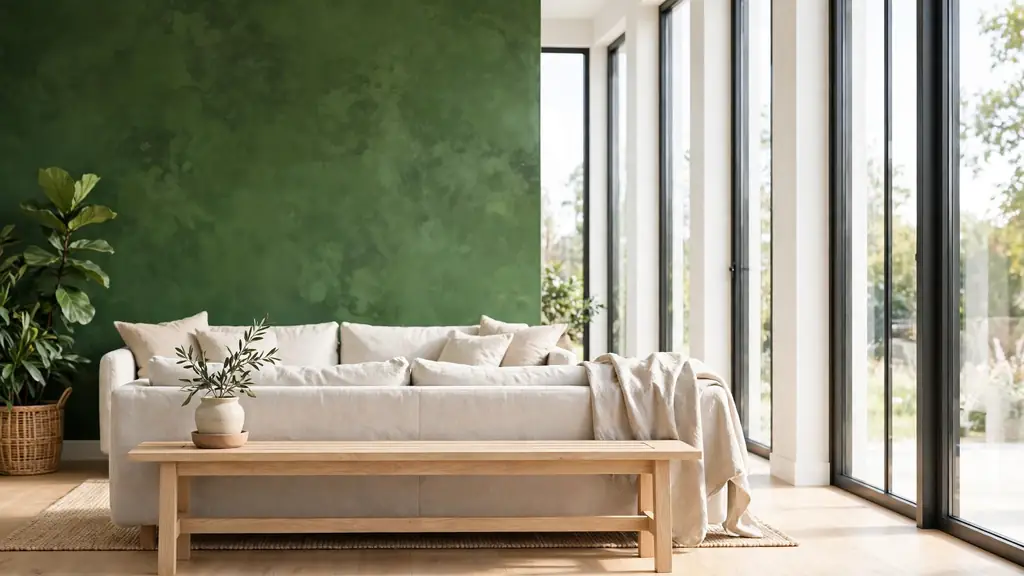
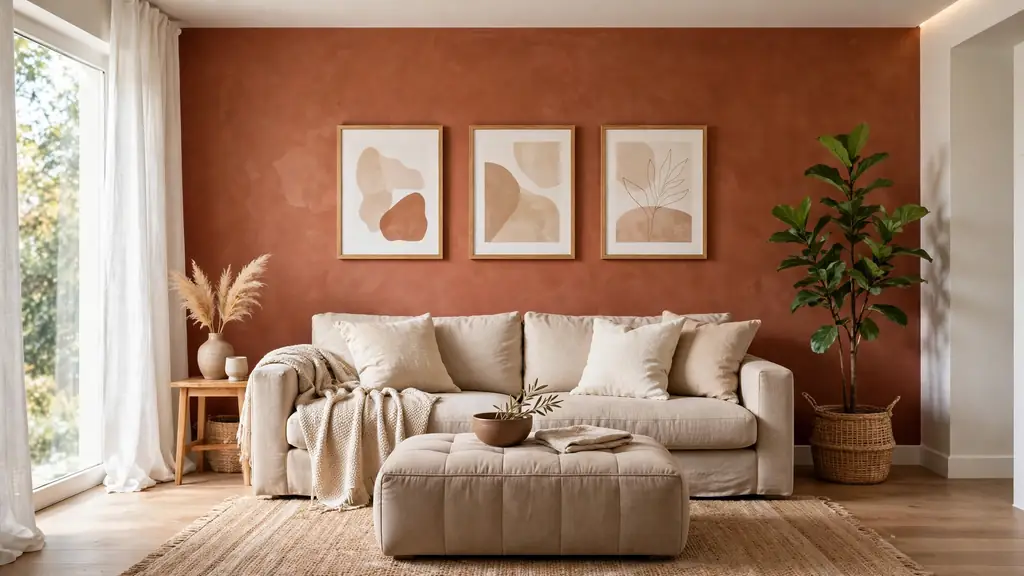
Ink blue, bottle green, aubergine, charcoal or a rich terracotta can make a room feel cocooned and expensive. The trick is to commit. A half-hearted mid-tone looks like a mistake, whereas a properly saturated shade looks intentional. Pair it with warm lighting and plenty of light-coloured textiles so the room doesn’t turn cave-like.
2. Colour blocking
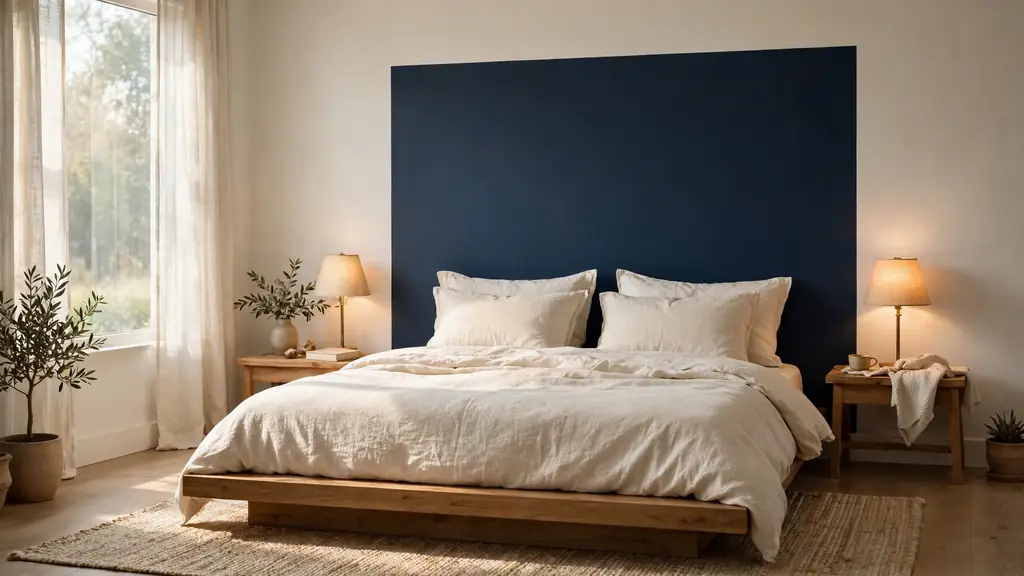
Instead of covering the full wall, paint large, clean-edged blocks of two or three colours. Try a tall rectangle behind a sofa, or a wall split horizontally at roughly two-thirds height. Colour blocking looks graphic and current, and it’s an excellent way to mix a bold shade with a neutral you already own.
3. A painted arch or circle
A painted arch behind a headboard, desk or console table is one of the most popular feature wall ideas of the last few years, and it deserves the attention. It gives the illusion of an architectural niche without any building work. Use a plate or string and pencil to mark a circle, or a paper template for a tall arch, then cut in carefully with a small angled brush.
4. A two-tone or half-painted wall
Paint the lower half of the wall in one colour and the upper half in another, with a crisp line or a slim strip of wood trim between them. It’s a classic that works in hallways, dining rooms and kids’ bedrooms. A darker bottom half grounds the room; a lighter one makes it feel taller.
5. Stripes and geometric shapes
Wide vertical stripes lift a low ceiling. Horizontal stripes widen a narrow room. Diagonals, chevrons and hexagon grids add playfulness, especially in children’s rooms and home offices. Painter’s tape is your best friend here, and a spirit level is your second best.
6. Limewash and textured paint
Limewash, mineral paint and sand-textured finishes give a soft, cloudy, almost plaster-like look that flat emulsion can’t match. The surface shifts with the light through the day, which is why designers love it for living rooms and bedrooms. It’s slightly more demanding to apply because the brushwork is part of the finish, but it hides imperfect walls surprisingly well.
Paint feature wall tips that save you from regret
- Test big swatches. Paint a one-metre square and look at it in morning, afternoon and evening light.
- Use the right sheen. Matt hides flaws; eggshell is easier to wipe in busy rooms; gloss works only on very smooth walls and makes a statement of its own.
- Link the colour to the room. Echo your feature shade in two or three small items such as cushions, a vase or a lampshade, so it feels planned.
- Carry the colour onto the ceiling for a wrapped, intimate look if the room can handle it.
Also Read: Kitchen Color Palettes Ideas: 25 Combinations That Actually Work in Real Homes
Wallpaper and Mural Feature Wall Ideas
If paint feels too plain, wallpaper is the natural next step. A single wallpapered wall delivers pattern, colour and texture in one go, and it’s far less overwhelming than papering an entire room. Wallpaper is also the easiest way to bring personality into a space, because there’s a print for almost every taste.
7. Bold pattern wallpaper
Large-scale florals, geometrics, Art Deco shapes, stripes and abstract brushstrokes all make memorable feature wall wallpaper. In a small room or a narrow hallway, go for a big print on a light background. Large patterns look surprisingly spacious, while tiny busy patterns can feel fussy.
8. Botanical and tropical prints
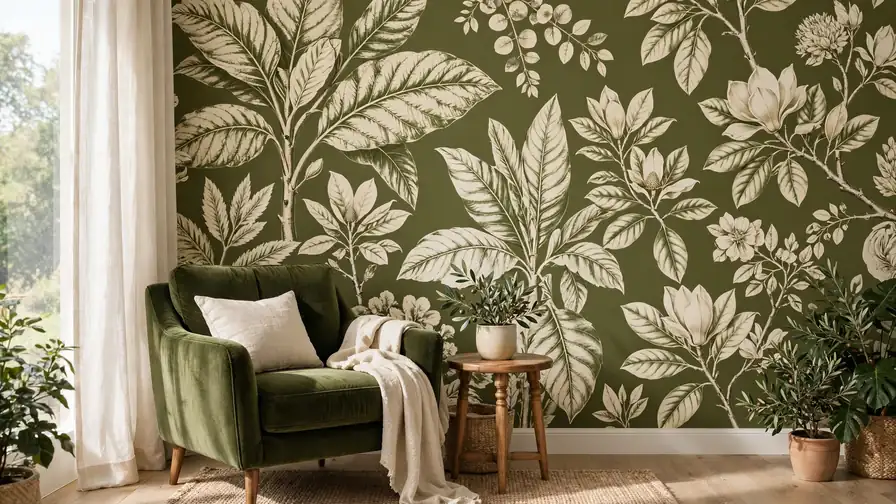
Palm leaves, banana leaves, birds and overgrown jungle scenes bring the outdoors in. They sit brilliantly behind a plain sofa or bed, and they’re a clever alternative when you can’t have real plants. Dark backgrounds feel dramatic and moody; pale ones feel airy and holiday-like.
9. Scenic wall murals
A mural turns a wall into a view. Misty forests, mountain ranges, vintage maps, painterly skies, abstract landscapes and soft watercolour scenes all work well. Because a mural is designed as one continuous image, it needs a clear, flat wall without too many doors or windows breaking it up. Keep furniture low in front of it so you can see the artwork.
10. Textured, metallic and grasscloth coverings
Grasscloth, linen-effect papers, embossed vinyls and subtle metallic finishes make a wall feel tactile without shouting. They’re particularly good in dining rooms and bedrooms, where soft evening light makes the surface shimmer gently. Ask for a sample and tilt it under a lamp before you buy.
11. Peel-and-stick wallpaper (the renter’s friend)
Removable wallpaper has come a long way. Modern peel-and-stick versions are thicker, easier to reposition and far less shiny than early versions. They suit rented homes, student rooms and anyone who wants a short-term refresh. Use them on smooth, well-painted surfaces; textured walls and fresh paint can cause bubbles and peeling.
How to make wallpaper look expensive
- Line up the pattern properly. Misaligned repeats are the number one giveaway of a rushed job.
- Paint the other walls a colour pulled from the print. Pick the second or third colour, not the dominant one.
- Use proper edges. Finish with clean skirting, a coving line or a slim trim so the paper looks framed.
- Hang it ceiling to floor. A half-height paper only works when you deliberately add a dado rail or border.
- Hire a pro for large murals. A tiny misalignment is very visible in a single big image.
Wall Panelling Ideas: Texture and Architecture Without Building Work
Panelling is the hottest answer to the question “what if a flat wall feels too boring?”. It adds shadow lines, depth and a sense of craftsmanship, and it works in both traditional and ultra-modern homes. The best part is that most panelling can be installed by a confident DIYer with a mitre saw, a spirit level and some patience.
12. Board and batten
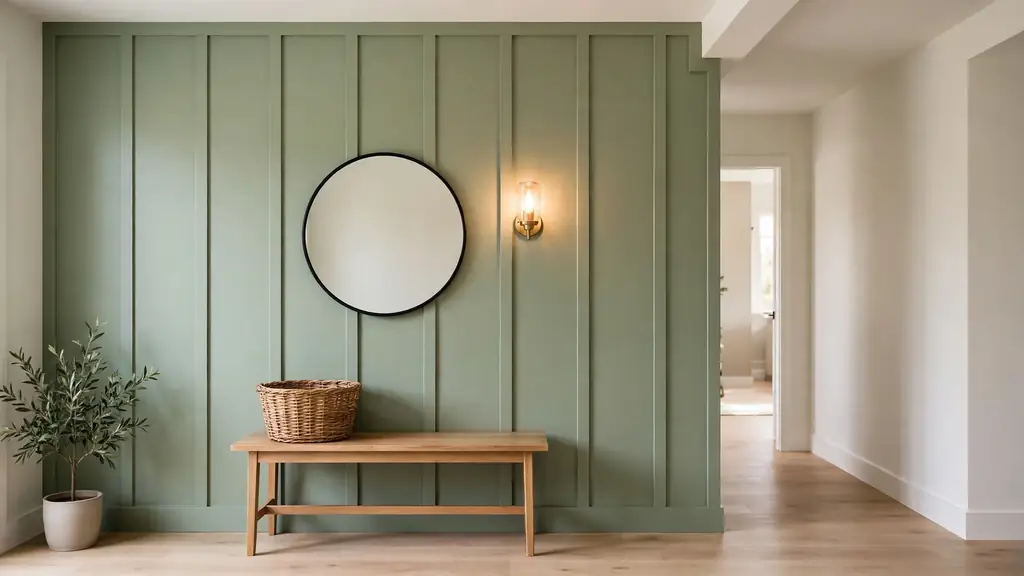
Board and batten uses vertical strips (battens) fixed over a flat backing, then painted as a single colour. It’s tidy, graphic and slightly farmhouse in feel, though it looks sharp in contemporary rooms too when painted in a muted tone. Great behind a bed, along a hallway or in a dining area.
13. Shiplap and tongue-and-groove
Horizontal boards with narrow grooves between them give a cosy cabin or coastal look. Paint them white for brightness, soft grey-green for calm, or deep navy for a nautical edge. Tongue-and-groove also works beautifully halfway up a wall, finished with a simple capping rail.
14. Classic wainscoting and picture-frame moulding
Rectangular frames made from thin moulding, painted the same colour as the wall, are the quiet luxury option. They look like they belong in an old townhouse. Paint the wall and the mouldings in one deep colour, and the result is elegant rather than loud. It’s especially flattering in dining rooms, hallways and formal living rooms.
15. Geometric and diagonal panelling
If traditional panelling feels too fussy, try diagonals, chevrons or large hexagon shapes cut from MDF strips. A diagonal pattern painted in one bold colour instantly adds energy to a plain wall. This is where you can get playful: in a teen’s room, a home gym or a creative studio, geometry feels fresh and unexpected.
Panelling tips from the workshop
- Measure the wall twice and plan symmetry. Centre the pattern on the wall or on the furniture in front of it. Awkward gaps at the edges are what make panelling look amateur.
- Fill and caulk every joint. A thin bead of decorator’s caulk between the panel and the wall makes shadow lines look crisp and keeps dust out.
- Use a primer that suits MDF. It soaks up paint, so proper priming saves you from three coats of blotchy finish.
- Work around sockets and switches carefully. Extend electrical boxes if the panelling sits proud of the wall, and always switch off the circuit first.
Slatted Wood and Acoustic Feature Wall Ideas
Vertical timber slats have become the signature look of modern interiors, and not just because they photograph well. They add warmth, rhythm and height, and they’re one of the few feature wall ideas that can also improve how a room sounds.
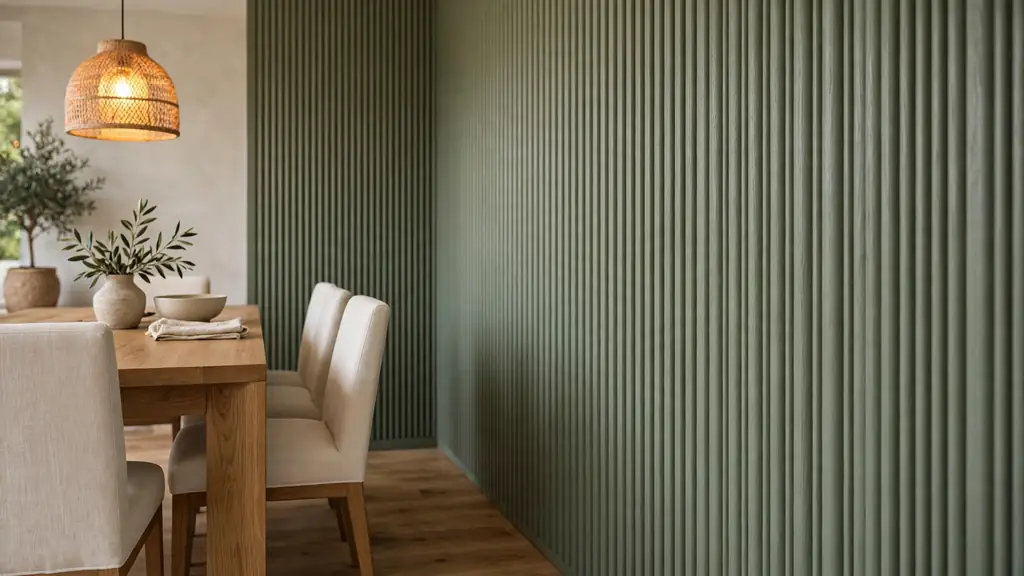
16. Vertical timber slats
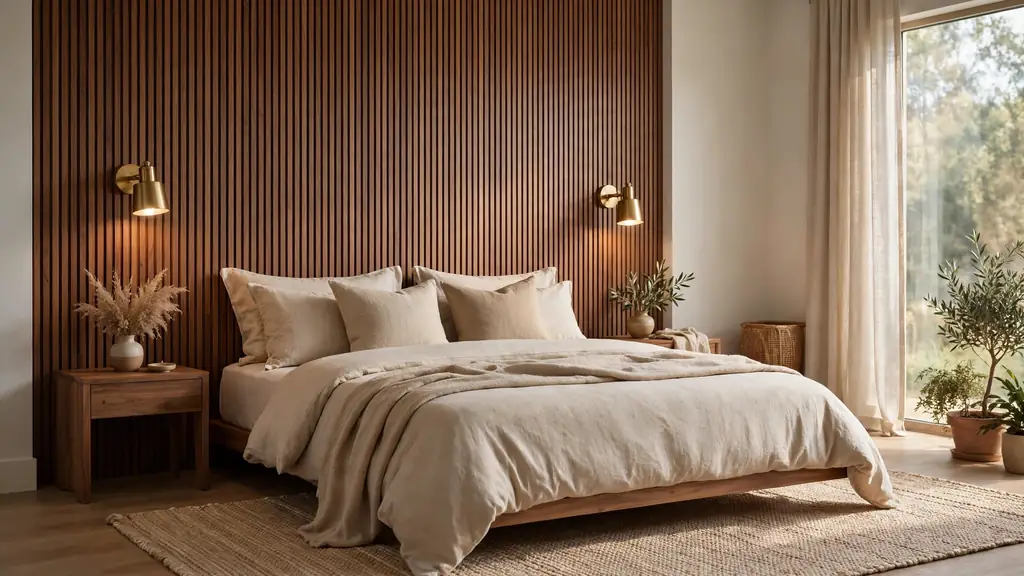
Straight wooden battens, spaced evenly, create a calm, Scandinavian-meets-Japanese look. Fix them over a dark backing, such as black felt or painted MDF, so shadows between the slats look rich and clean. Use them behind a bed as a built-in headboard, around a TV, or as a room divider at the end of a hallway.
17. Herringbone and parquet wood walls
We’re used to herringbone on floors, but it looks incredible on a wall too. A herringbone or basket-weave wood wall feels crafted and slightly vintage. It pairs well with modern minimal furniture because the pattern does the talking. Keep the rest of the room simple.
18. Fluted, reeded and acoustic panels
Fluted panels (rounded, half-pipe profiles) are the softer cousin of straight slats. Many come as ready-made sheets, which makes installation faster than cutting dozens of individual battens. Acoustic versions with a felt backing absorb echo, which helps in open-plan rooms, home offices and media rooms. If you work from home and spend your day on calls, this idea earns its keep.
Choosing wood for a feature wall
- Oak and ash give a light, airy Scandinavian feel.
- Walnut is rich and dramatic, ideal behind a bed or a media unit.
- Painted MDF costs less and lets you match any colour in your scheme.
- Reclaimed timber brings character and imperfection, but check it for pests and finish it properly.
Whatever you choose, seal the wood and avoid placing it right next to a radiator or in a steamy bathroom unless it’s rated for moisture.
Brick, Stone, Plaster and Tile Feature Wall Ideas
If you love an honest, tactile finish, natural and mineral materials deliver something paint never quite can: weight. These walls feel permanent, and they age well.
19. Exposed or faux brick
Exposed brick is the dream of anyone who loves an industrial loft. If you’re lucky enough to have it behind plaster, a careful strip-back can be worth it, though check with a professional first because old brickwork may be structural or crumbling. If you don’t have it, lightweight brick slips or brick-effect panels give a convincing result. Paint brick white for a lighter, Scandinavian feel, or leave it raw and pair it with leather, steel and warm timber.
20. Natural or stacked stone
Stacked stone cladding suits fireplaces and media walls beautifully. It’s heavy, textural and slightly rugged, so it works best in generous rooms or on a single wall as a bold counterpoint to smooth, soft furnishings. Lighter faux-stone panels are available if the wall can’t take the weight of real stone.
21. Venetian and faux plaster
Polished plaster and microcement walls look like a gallery. They have subtle cloudy movement, a faint sheen and a calm, luxurious feel. Done well, they’re stunning behind a bed or a freestanding bath. They’re also a skilled job: if you’re keen on this look, hire a plasterer, or start with a limewash-style paint to get a similar effect.
22. Marble and marble-effect slabs
A slab of marble behind a fireplace or a vanity looks like a piece of art. Real marble is pricey and needs sealing, so many people go for porcelain slabs that mimic its veining but are lighter and tougher. Combine with brass or matte black details and slim lighting to keep it elegant.
23. Feature tile
Tile isn’t just for kitchens and bathrooms. Zellige, herringbone, hexagon, fluted ceramic and ombre tiles make strong statements behind a bed, a bar cart or a stove. Choose matte finishes for a soft look or glossy ones to bounce light around a dark corner.
Gallery Walls, Mirrors, Shelving and Art: Feature Walls Without Renovation
Not every feature wall has to be a surface treatment. Sometimes the most effective idea is simply to fill a wall with things you love.
24. The gallery wall
A well-planned gallery wall turns frames, prints and objects into a single composition. It’s one of the easiest and most personal feature wall ideas, perfect for stairways, sofa walls and hallways. The secret is planning. Lay out frames on the floor or trace them on paper first, keep a consistent gap (around five to eight centimetres works well), and anchor the arrangement around a central piece. A tight palette of black frames, or a mix of warm woods, helps a collection of different art feel unified.
25. A mirror wall
A large mirror, or a grid of smaller ones, bounces light around and makes small rooms feel bigger. Place a big mirror opposite a window to double the daylight, or lean an oversized floor mirror against a wall for a relaxed, no-drill alternative. Arched and round mirrors are especially popular right now.
26. A floor-to-ceiling shelving wall
A full wall of bookcases or open shelving is a feature wall that works hard. Paint the back panel a deep contrasting colour such as green or navy, light the shelves from within and style them with a mix of books, ceramics, art and plants. It’s equally good in a living room, a library nook or a home office.
27. One oversized piece of art or a tapestry
A single huge canvas, woven tapestry or large textile hanging can carry an entire wall on its own. This minimalist approach suits modern rooms and renters, and swapping the piece changes the whole atmosphere without any decorating.
Living Room Feature Wall Ideas
The living room is where most feature walls live, and where the stakes are highest, because it’s the room you and your guests look at the most. Beyond the materials above, two setups deserve their own attention.
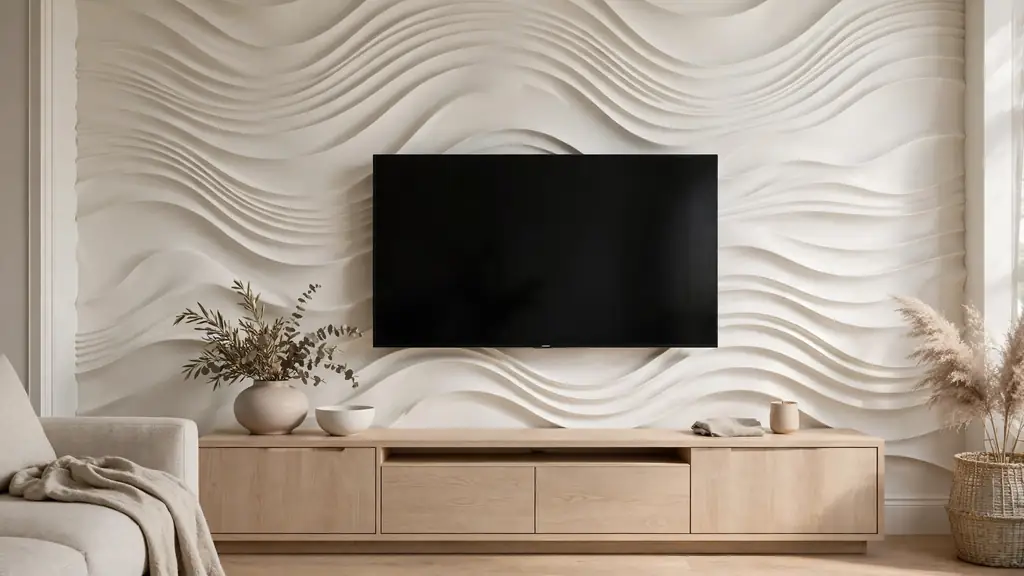
28. The TV or media feature wall
Black screens are the enemy of a good-looking room. A media wall solves that by making the TV part of the design rather than something stuck onto it. Options include:
- A slatted or panelled wall with the TV mounted in the middle and hidden cables running behind the surface.
- A built-in unit with closed storage below, open shelves on the sides and a recessed alcove for the screen.
- A dark painted wall that lets the TV disappear into the colour when it’s off.
- A stone, plaster or marble-effect backdrop for a luxe, gallery-style setup.
If you’re building a timber-frame media wall, run power and data cables to the TV position before you close anything up, use sturdy fixing points where the screen will hang, and leave ventilation space around any equipment. Add soft lighting around or behind the unit to avoid harsh contrast between the bright screen and a dark wall.
29. The chimney breast or fireplace wall
The chimney breast is practically begging to be a feature. Painting just the projecting part, in a darker or contrasting colour, turns it into an instant focal point. You can also wallpaper it with a bold print, clad it in stone, panelling or tile, or flank it with matching shelves and wall lights. Even if the fireplace isn’t in use, styling the mantel with art, candles and plants keeps the focus there.
Also Read: Christmas Mantel Decor Ideas: 21 Stunning Ways to Style Your Fireplace This Holiday Season
Layout tips for a living room feature wall
- Choose the wall your seating naturally faces.
- Keep the rest of the walls soft: warm white, pale greige or a muted tint of your feature colour.
- Add layers in front of the wall. A console table, floor lamp, tall plant or sculptural chair stops a feature wall from looking flat.
- Mind scale. A big sofa deserves a substantial wall treatment; a tiny wall of delicate pattern looks lost behind it.
Bedroom Feature Wall Ideas
Which wall should be the feature wall in a bedroom? Almost always the one behind the bed. It’s the first thing you see when you walk in, it’s rarely broken up by windows, and nobody is watching a screen against it. That makes it the ideal place for something calming, textured or just plain beautiful.
30. The headboard wall
Instead of buying a big headboard, build the headboard into the wall. A few ways to do it:
- Painted headboard shape. An arch, a rectangle or a soft-edged panel painted in a deeper shade behind the bed.
- Slatted or fluted panels that double as a headboard and help soften sound.
- Upholstered wall panels in boucle, linen or velvet for a hotel-suite feel.
- Wallpaper in a restful pattern with plenty of breathing room around it.
- Panelling to the height of the top of the headboard or the full height of the wall.
A wall-mounted headboard also makes small bedrooms feel more open, because it leaves the bed itself visually lighter.
31. Wrap the wall into the ceiling
If you really want to be daring, carry the colour or wallpaper from the headboard wall onto the ceiling. In a bedroom this creates a cocoon effect that feels deliberate and cosy, and it’s brilliant in rooms with sloping ceilings or an eaves-style layout.
Keep bedrooms restful
Sleep rooms need calm. Stay in the soft end of the spectrum: sage, clay, dusty blue, warm greige, deep forest or cocoa brown. Avoid busy, high-contrast patterns directly in your eyeline when you’re in bed, and layer in lamplight rather than relying on a single overhead fitting. If you share the room with a partner, test the colour together, because dark shades can feel dramatic in the evening and heavy in the morning.
In a small bedroom, a feature wall at the far end of the room or behind the bed adds interest and depth without crowding the space.
Also Read: Fall Bedroom Decor Ideas: 30 Cozy Ways to Style Your Room for Autumn
Feature Wall Ideas for Dining Rooms, Hallways, Bathrooms, Offices and Outdoors
Living rooms and bedrooms get all the attention, but some of the best feature walls are in the spaces nobody expects.
32. A dining room statement wall
A dining room is a social space, so it can handle drama. A moody paint colour, a mural, a mirrored wall or classic picture-frame panelling makes dinner feel like an occasion. Hang a big mirror opposite a window to bounce candlelight around the room at night, or run a long shelf along the feature wall for plates, plants and objects.
33. A hallway or staircase wall
Hallways are often forgotten, which is exactly why a feature wall works here. They’re a transition space, so you can be bolder than you’d be in a room you sit in all day. Try a bold wallpaper, a gallery wall climbing the stairs, a deep colour with a lighter ceiling, or vertical panelling that adds height. In a narrow corridor, keep the pattern large and the background light so it doesn’t feel claustrophobic.
34. A kitchen or bathroom feature wall
Wet rooms need materials that cope with moisture, but that doesn’t mean boring.
- Bathroom: large-format porcelain, zellige or fluted tile behind the bath or vanity; a coloured microcement or tadelakt finish; or moisture-resistant wallpaper away from the splash zone. A moody painted wall with a round mirror and brass fittings can also look fantastic.
- Kitchen: a bold tile splashback, a painted wall behind open shelves, or a single wall of colour opposite the cabinets. Use wipeable, kitchen-rated paint in cooking areas.
Always check that a material is rated for bathroom or kitchen conditions, especially near showers and hobs.
35. Home office feature walls
Pick the wall behind your desk and you’ll look good on every video call. A deep green, navy or a slatted acoustic wall frames you nicely, reduces echo and keeps the room from feeling bland. A shelving wall or a pinboard of inspiration adds function.
36. Outdoor and garden plant walls
Feature walls don’t stop at the front door. A painted garden wall, a slatted privacy screen, a mural on a courtyard wall or a vertical garden of trailing plants and herbs turns a blank boundary into a talking point. Use exterior-grade paint and materials designed to handle rain and sun, and plan irrigation or drainage if you choose a living wall. Even a small balcony benefits from a single coloured wall paired with a couple of well-chosen planters.
Small Rooms, Rentals and Budget-Friendly Feature Wall Ideas
You don’t need a big space or a big budget to pull off a feature wall. Constraints usually make the result more creative.
Feature walls for small rooms
It’s a myth that small rooms must stay pale and plain. A feature wall can make a compact space feel more interesting and even bigger when handled thoughtfully:
- Choose the far wall, so the room appears to stretch away from the door.
- Use mirrors or glossy finishes to reflect light.
- Pick large-scale patterns on light backgrounds, or tone-on-tone textures such as soft panelling or limewash.
- Go vertical. Tall stripes, slats or full-height curtains draw the eye upward and make ceilings feel taller.
- Keep furniture simple and low so the wall isn’t competing with a heavy sofa or bulky shelves.
A dark colour can work in a small room too, as long as it’s lit properly and the other walls are soft. The result is cosy, not cramped.
Also Read: 56 Studio Apartment Ideas to Make One Room Feel Bigger, Smarter and Way More Like Home
Renter-friendly feature walls
If you can’t paint or drill, you still have good options:
- Peel-and-stick wallpaper or removable panels on a smooth wall.
- A large leaning mirror or oversized art that sits on the floor.
- Fabric or tapestry hangings held up with removable hooks or a slim rod.
- Freestanding shelving or a bookcase painted in a bold shade.
- Self-adhesive slat panels or felt acoustic panels that remove cleanly.
- Washable paint swatches or removable decals for shapes and stripes.
Always test a hidden corner first, and read your tenancy agreement before changing anything permanent.
Budget-friendly feature wall ideas
| Idea | Effort | Cost level | Best for |
|---|---|---|---|
| Painted block, arch or stripes | Low | Low | Any room, quick refresh |
| Gallery wall | Low | Low to medium | Sofa walls, stairs, hallways |
| Peel-and-stick wallpaper | Low | Low to medium | Rentals, small rooms |
| Board and batten with MDF | Medium | Low to medium | Bedrooms, dining rooms |
| Slatted panels (ready-made) | Medium | Medium | TV walls, headboards |
| Wallpaper mural | Medium | Medium | Statement living rooms |
| Real stone, marble or tile | High | High | Fireplaces, bathrooms, kitchens |
| Venetian plaster | High | High | Luxury bedrooms and living rooms |
Prices vary widely by country, supplier and wall size, so use the table as a relative guide rather than a quote. To keep costs down, buy sample pots and paper samples before committing, ask suppliers about discontinued rolls, and consider doing the prep yourself while leaving the specialist finishing to a professional.
Lighting, Texture and Styling: How to Make Any Feature Wall Look Finished
A feature wall isn’t finished when the last coat of paint dries. Lighting and styling decide whether it looks designed or just decorated.
Light the wall deliberately
- Wall washers or picture lights make colour and texture glow.
- Wall sconces on either side of a headboard, mirror or fireplace create symmetry and warmth.
- Hidden LED strips behind slats or in shelving add a modern glow.
- Dimmers let the wall shift from daytime bright to evening cosy.
- Warm white bulbs (around 2700K) flatter most colours in living rooms and bedrooms.
Layer, don’t just decorate
A feature wall needs something in front of it. Add a sculptural lamp, a trailing plant, a bench, a console or a pair of chairs. Soft furnishings like cushions, throws and rugs in colours picked from the wall tie everything together.
Mix textures
If the wall is smooth and glossy, bring in wool, linen, rattan or boucle elsewhere. If it’s rough or heavily textured, balance it with polished metal, glass or ceramics. A room full of one texture feels flat, however beautiful that texture is.
Keep the rest of the room quiet
The other three walls are the supporting cast. Warm white, pale greige or a lighter tint of your feature colour keeps the star wall in the spotlight.
Feature Wall Colours and Trends to Watch
Trends move quickly, but a few directions keep showing up in designers’ schemes. Use them as inspiration, not as rules.
Colour combinations that work
- Deep green + warm white + natural oak: calm, grown-up and very easy to live with.
- Navy + cream + brass: classic, a little nautical and polished.
- Terracotta + sand + olive: earthy, sunbaked and relaxed.
- Charcoal + soft grey + black metal: sleek, industrial and moody.
- Dusty pink + sage + walnut: soft, gentle and slightly retro.
- Chocolate brown + cream + rust: warm and cosy, ideal for bedrooms and snugs.
- Warm white + warm white: a monochrome scheme where the interest comes entirely from texture such as plaster, slats or panelling.
Trends shaping feature walls right now
- Texture over flat colour. Designers keep repeating the same point: a plain coat of contrasting paint isn’t enough anymore. People want texture, whether that’s limewash, fluted timber, plaster or panelling.
- Mixed materials. Painted sections combined with timber mouldings, a band of tile, or a strip of wood trim feel personal rather than catalogue-perfect.
- Warm, earthy palettes. Clay, mushroom, olive, cocoa and soft rust are replacing cold greys.
- Acoustic and functional walls. Slats, felt and fabric panels that cut echo are crossing from offices into homes.
- Wrapped rooms. Some designers prefer treating every wall, so a feature wall may be part of a continuous scheme with the same colour carried across the ceiling and trim.
- Handmade and artisan details. Tapestry, hand-glazed tile, plaster and bespoke mural work bring a crafted feel.
The lesson: a feature wall that follows a trend should still feel like it belongs in your home. If you love it in five years’ time, it was the right choice.
Feature Wall Mistakes to Avoid
Most feature wall disappointments come down to the same handful of errors. Avoid these and you’ll be ahead of most people.
1. Choosing the wrong wall
A wall interrupted by doors, windows and heavy furniture is a poor candidate. So is a wall you rarely look at. Go back to the section on choosing your wall and trust your first instinct from the doorway.
2. Relying on colour alone
A flat contrasting colour can look like an afterthought. Add depth with texture, a trim detail, lighting or a considered arrangement of furniture in front of it.
3. Ignoring the rest of the room
A brilliant feature wall can’t rescue a room with mismatched furniture, clashing colours and poor lighting. Link the wall to the room with two or three repeated colours or materials.
4. Going too small or too timid
A feature wall should be confident. A dainty pattern on a huge wall, or a colour so close to the others that nobody notices the difference, simply looks like a mistake.
5. Going too bold for the space
The opposite problem: huge, high-contrast prints in a tiny room, or a neon shade where you’ll be spending long evenings. Scale matters.
6. Forgetting prep
Bumpy walls, old paint, damp patches and cracks will show through any finish, especially glossy paint and thin wallpaper. Fill, sand, prime and let everything dry before you start.
7. Skipping the samples
Colours change dramatically depending on light. Test big swatches, not tiny cards, and look at them at different times of day.
8. Hiding the structure behind panelling without planning
Check for radiators, sockets, pipes, cables and switches before you panel or clad a wall. Moving them later is expensive and messy.
9. Following a trend you don’t love
If a look doesn’t feel like you, it will date, or irritate you, faster. Pick what you genuinely enjoy living with.
How to Plan and Create a Feature Wall, Step by Step
Whatever material you choose, the process follows the same path. Work through it in order and the job goes more smoothly.
- Pick the wall and the idea. Decide which wall earns the spotlight and which look suits your room, your lifestyle and your skills.
- Set a realistic budget. Include materials, tools, adhesive or fixings, primer, trim, lighting and a small buffer for surprises.
- Collect samples. Order paint swatches, wallpaper samples or material offcuts. Tape them on the wall and look at them for several days.
- Check the wall. Look for damp, cracks, loose plaster and hidden services. Fix problems first, because no finish will cure a damp wall.
- Prepare the surface. Clear the furniture, protect the floor, remove old fixings, fill and sand holes, wipe away dust and prime where needed.
- Mark it out. Use a spirit level and pencil to mark panel lines, stripes, arches or wallpaper drop lines. Measure twice before cutting or painting.
- Install or apply. Paint with a good roller and a small brush for edges, hang paper from the centre outward, or fix panels and slats with the right adhesive and fixings for your wall type.
- Finish the edges. Caulk gaps, touch up trim, and fit skirting, coving or capping so the wall looks framed.
- Add lighting and styling. Position lights, furniture, art and plants once everything is dry and fully cured.
- Step back. Live with it for a week before you add more. Often a feature wall needs less decoration than you expect.
DIY or hire a professional?
Paint, peel-and-stick paper, simple panelling and gallery walls are well within reach for most beginners. Hire help for large murals, plaster finishes, stone or tile cladding, anything involving wiring or plumbing, and heavy media walls that need secure fixings. A good tradesperson costs money, but a poor result costs more.
Final Thoughts on Feature Wall Ideas
A great feature wall isn’t about following a formula. It’s about choosing one wall, giving it a clear job and letting the rest of the room step back. Maybe that job is warmth behind a bed, drama in a dining room, texture behind a TV or simply a flash of personality in a hallway you walk through every morning.
Start with the wall that naturally draws your eye, pick a material that suits your lifestyle and budget, test your samples in real light and finish the job with good lighting and a few well-chosen layers. If you take only one thing from this guide, make it this: be confident. A feature wall that feels bold and considered will always beat one that feels timid and accidental.
Pick your favourite from the 36 feature wall ideas above, grab a sample, and start with the wall in front of you. Your room is waiting.
Frequently Asked Questions
What is a feature wall?
A feature wall is one wall in a room that is deliberately different from the others. It might be painted a bold colour, covered in wallpaper or made from wood, tile, plaster or stone. The idea is to pull the eye to one place and give the room a clear focal point. A good feature wall adds depth and personality without making the room feel busy.
Which wall should be the feature wall?
Choose the wall your eye naturally lands on when you walk in. In a living room, that is usually the wall behind the TV or sofa. In a bedroom, it is usually behind the bed. Avoid walls with lots of doors or windows, because you lose the clean visual block that makes a feature wall work. If you are not sure, stand in the doorway and see which wall your eyes go to first.
Are feature walls still in style?
Yes, but the style has moved on from a single bright colour. Today’s feature walls are about texture, pattern and natural materials, such as limewash, wood slats, plaster, stone and tonal wallpaper. They look best when they match the rest of the room, so avoid harsh contrasts and dated colour choices. If you want a classic look, choose one wall in a deeper shade of the room’s existing palette.
What are the cheapest feature wall ideas?
Paint is almost always the cheapest route. A single tin of paint and a weekend is enough for colour blocking, a painted arch, a two-tone wall or painted stripes. An accent wall in a deep, rich colour will cost you about $20-$100 for paint and materials. Peel-and-stick wallpaper costs more, but it is still one of the best renter-friendly options, and it can cost less than $50-$200 to create a wallpaper feature wall.
Can a feature wall make a small room look bigger?
Yes, if you choose the right type of feature wall. A pale, reflective colour, a mirror wall, a pale wallpaper or a wall with vertical panelling can all make the room look taller and larger. Avoid dark paint on the far wall, as it can make narrow rooms look like corridors. A single feature wall in a rich, dark shade can make a room feel cosy and intimate, but it should not distract from the overall room.
What colour should I paint a feature wall?
Pick a colour that already appears in the room. Look at the sofa cushions, the rug, the artwork or the curtain colour. A warm grey, forest green, navy blue or terracotta all work well in a modern room. Try the colour on a sample area first and look at it in daylight and at night before you commit to the whole wall.
Is wallpaper or paint better for a feature wall?
Neither is better overall. Paint is cheaper, faster and easier to change. Wallpaper has texture and pattern that paint cannot replicate, and it is now available in peel-and-stick removable options. If you love bold pattern, wallpaper can be a better choice. If you want a calm, tonal look, painted texture, limewash or plaster can be the best choice.
How do I make a feature wall around a TV?
Design the wall around the TV, not the TV in isolation. Use the same material for the whole wall, such as wood slats, panelling or a 3D wall panel, and mount the TV at eye level when seated. Add built-in storage and shelves for a remote and accessories, and add lighting to keep the wall from looking flat and black. A dark wall will hide the screen, but a deep, rich colour will still show off a large TV.
Can I create a feature wall in a rented home?
Yes. Use removable wallpaper, peel-and-stick tiles, self-adhesive panels or a tapestry. You can also lean a large piece of art against a main wall without needing to drill. To avoid damaging the plaster, check what your landlord or lease permits and what your deposit is. If you are painting, talk to your landlord first.
How many feature walls should a room have?
Usually one. The whole point of a feature wall is that it is different from the rest of the room. If two walls are bold, neither is a feature; they compete instead. The exception would be if one wall has a large mural and another has a subtle texture. But if the walls are both strong and bold, it will be too much.