

If your washer and dryer live behind a pair of bifold doors in a hallway, or wedged into what used to be a coat closet, you already know the problem. The machines fit, just barely. Everything else (detergent, dryer sheets, the stain stick you can never find, the basket that somehow always ends up on the floor) fights over whatever inches are left.
The good news is that small laundry closet ideas have come a long way. Between slim pull-out carts, fold-down counters, retractable drying racks and renter-safe wallpaper, a laundry closet can feel calm, organized and even a little pretty. You don’t need to knock down a wall or hire a contractor for most of it.
This guide walks you through everything in the order you’ll actually need it: how to measure and plan, which layout suits your closet, 25 practical small laundry closet ideas for storage, folding, drying, doors, style and lighting, plus ventilation rules, budgets, common mistakes and a simple upkeep routine. Whether you own your home in the suburbs or rent an apartment with a hallway closet, you’ll find something you can use this weekend.
Small Laundry Closet Ideas at a Glance
Short on time? These are the moves that deliver the biggest improvement for the least effort in almost every laundry closet:
- Stack the machines (front-load washer plus matching dryer with a stacking kit) to free up floor space.
- Add a deep floating shelf above the dryer for baskets and bottles.
- Use the back of the door for hooks, a slim organizer or a hanging rack.
- Install a fold-down shelf or pull-out board so you finally have somewhere to fold.
- Mount a retractable or wall-mounted drying rack for delicates and sweaters.
- Swap swing doors for bifold, sliding, pocket or louvered doors so you can actually stand in front of the machines.
- Keep air moving. A dryer needs a proper vent path and breathing room, always.
- Finish with peel-and-stick wallpaper, new hardware and LED lighting so it feels like a room, not a cupboard.
What Is a Laundry Closet (and Why Small Ones Are So Tricky)?
A laundry closet is an enclosed nook that houses a washer and dryer, usually behind a door, in a hallway, bathroom, kitchen corner, bedroom or entryway. It’s a favorite in apartments, condos, townhomes and older houses where there’s simply no room for a full utility room. Compared with a dedicated laundry room, a closet gives you a fraction of the floor area and almost no counter space, which is why the best small laundry closet ideas lean on vertical space and multi-purpose gear.
The challenge isn’t just size. It’s the combination of heat, moisture, lint, plumbing connections and electrical needs packed into a tight box. A washer and dryer need water supply lines, a drain, an outlet (120V or 240V depending on the dryer) and, for most dryers, a vent to the outdoors. Add shelves, baskets and a door, and every decision starts to affect the others. Good planning up front saves you from the classic mistakes: shelves hung too low to open the dryer door, doors that bump the machines, or a vent that’s crushed behind a stacked set.
The upside? Small spaces reward intention. When you only have a few square feet, every hook and shelf has to earn its place, and the end result is usually more organized than a big laundry room full of random clutter.
Before You Start: Measure, Plan and Check the Basics
Almost every regret people have with a laundry closet traces back to skipping this step. Spend twenty minutes with a tape measure and a notepad before you buy a single basket.
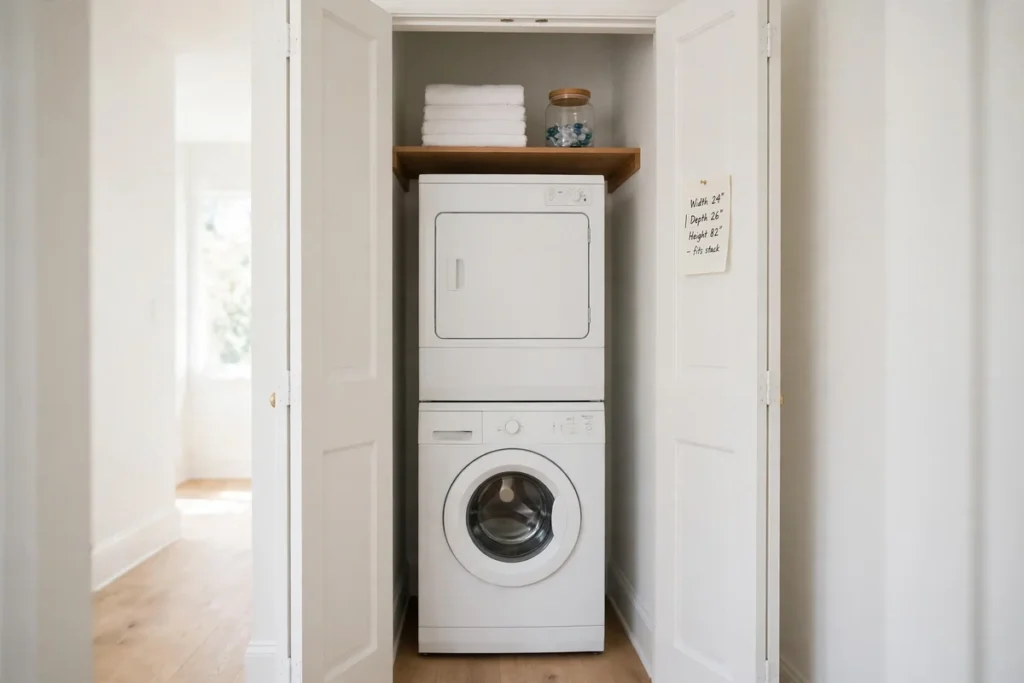
Measure Width, Depth and Height (Three Times)
Measure the closet’s interior width, depth and ceiling height at more than one point, because old walls are rarely square. A compact stacked washer and dryer commonly needs roughly three to four feet of width and about three feet of depth, but sizes aren’t standardized and they vary by brand and country, so always check the specification sheet for the exact models you own or plan to buy. Measure the door opening too. Appliances have to travel through it on delivery day.
Leave Breathing Room Around the Machines
Installation guides for stackable units typically call for about an inch at each side and one to two inches behind for hoses and venting, with front clearance of roughly 24 to 36 inches for loading and folding. Treat those as ballpark figures and follow your appliance’s own installation manual, since the manufacturer’s numbers win. Extra width also pays off later when a technician needs to get behind the machines.
Confirm Water, Drain, Power and Vent
Check that your closet has hot and cold water shut-off valves, a standpipe or drain, an electrical outlet that matches your dryer (some dryers use 120V, others need 240V) and a way to vent a vented dryer outdoors. If you’re renting, ask your landlord before you change anything permanent. If any of these utilities are missing, you’ll want a licensed plumber or electrician rather than a DIY fix.
Decide What Has to Live in the Closet
List what you really use each week: detergent, fabric softener, stain remover, dryer balls, a lint brush, a handful of hangers, maybe an iron. Everything on that list needs a home within arm’s reach. Everything else (the extra bulk detergent, the seasonal linens) can move to a hall cabinet or under a bed. This one decision will shape your whole storage plan.
Choosing the Right Layout for Your Laundry Closet
Your layout decides how many of the small laundry closet ideas below will work for you. Here are the main options.
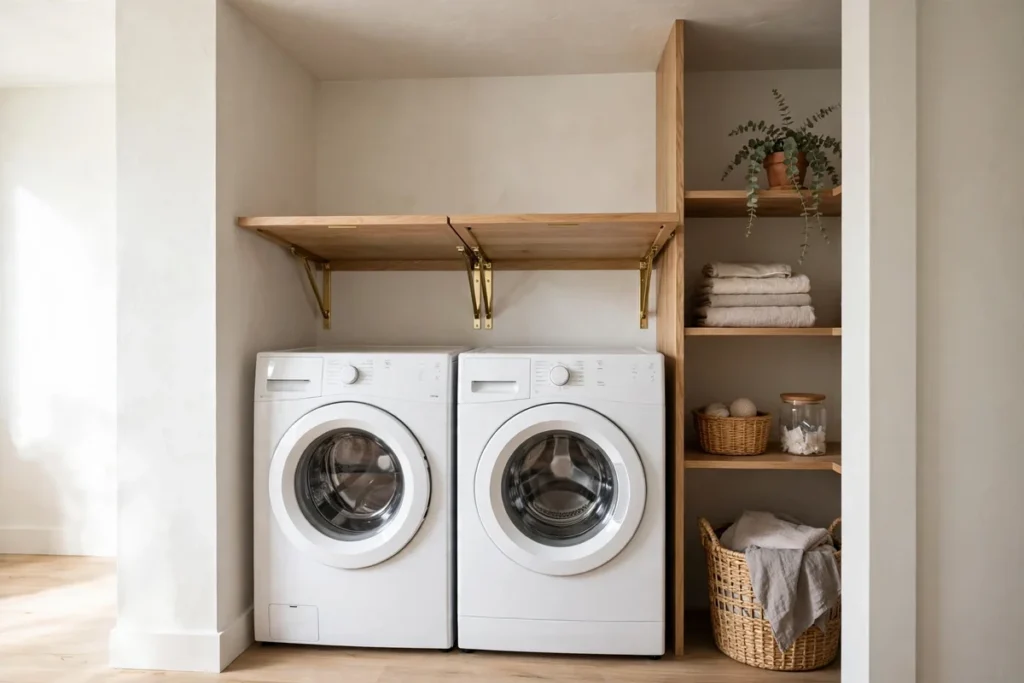
Stacked Washer and Dryer
For most closets this is the winner. Stacking a dryer on top of a front-load washer cuts the footprint roughly in half and leaves the wall space above for shelves. Only front-load machines designed for stacking should be stacked, and they need the manufacturer’s stacking kit so the dryer can’t shift while it runs. The trade-off is height: the controls and lint trap sit higher, which can be awkward for shorter users, and you’ll want the shelves positioned above the top of the dryer with enough room to open the door and lift the lid of the detergent drawer.
Side-by-Side Washer and Dryer
If your closet is wide and shallow, side-by-side machines let you put a countertop across the top. That gives you a built-in folding surface, which is gold in a tiny space. You lose some vertical storage, but you gain a work area. Under-counter shelving or a pull-out hamper beside the machines can make up the difference.
All-in-One Washer-Dryer Combo
A single washer-dryer combo needs only one footprint and one set of connections. Many models are ventless, which means no duct to run outside, so they suit apartments and interior closets well. The trade-off is longer cycle times and smaller loads, so they work best for singles, couples or light users.
Compact 24-Inch Units
European-style 24-inch machines are narrower than the standard 27-inch American size and often come in ventless heat pump or condenser versions. If your closet is truly tiny, these may be the difference between having an in-unit laundry and heading to the laundromat.
Storage-Focused Small Laundry Closet Ideas
Storage is where most people get stuck, because the floor is gone and the walls are all you have. These small laundry closet ideas make the vertical space do the heavy lifting.
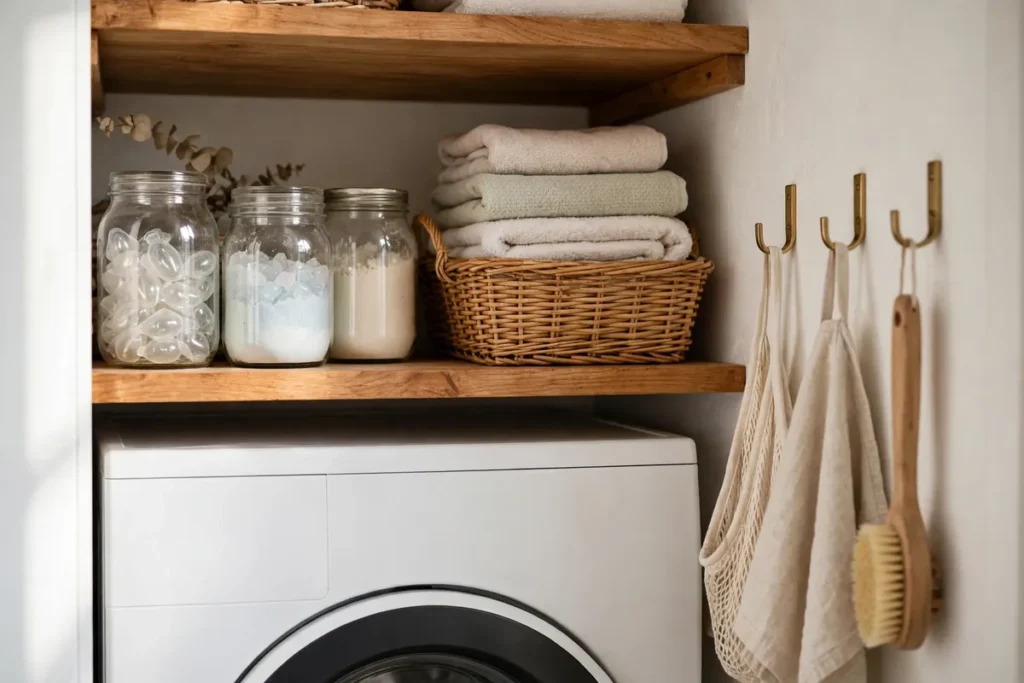
- Install Deep Floating Shelves Above the Machines
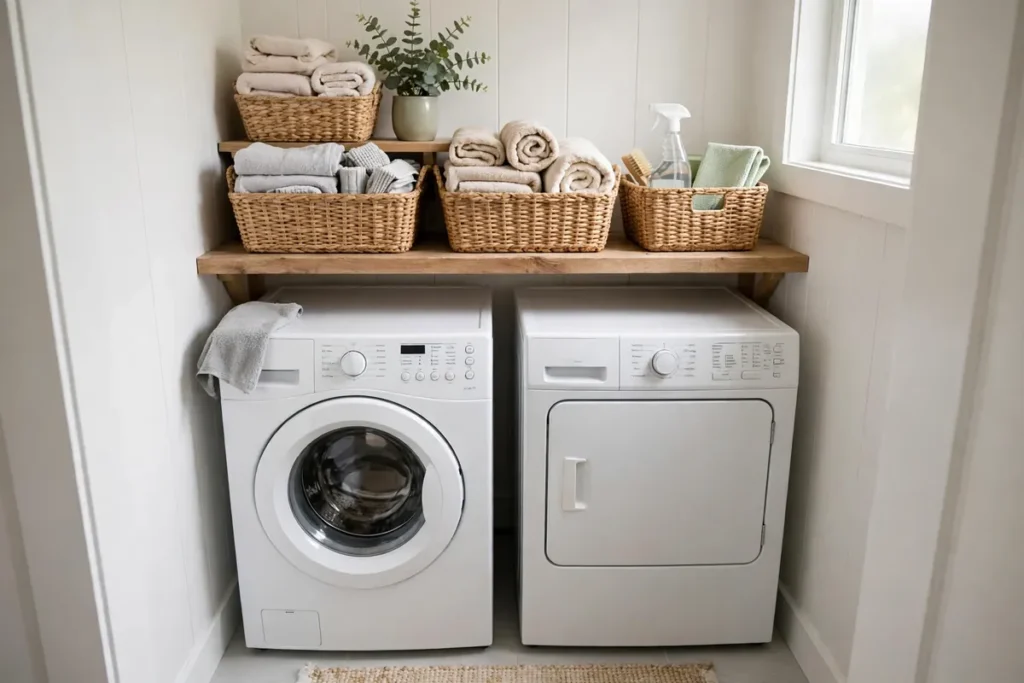
The wall above the dryer is the most valuable real estate in the closet. Deep floating shelves (around 10 to 12 inches) hold baskets, canisters of detergent pods and spare linens. Space two or three shelves to fit your tallest bottle and leave enough room beneath the lowest one to open the dryer door and reach controls comfortably. In a rental, bracket-and-board shelves screwed into studs are sturdier than any adhesive option, but ask permission first.
- Use Matching Baskets and Labels
Woven or fabric baskets hide visual clutter and make shelves look intentional. Give each one a job (stain treatment, dryer sheets, lint rollers, socks without partners) and add a simple label so everyone in the house puts things back in the right spot. Clear containers work well for items you want to see at a glance, like detergent pods.
- Add a Slim Rolling Cart Between or Beside the Machines
If you have a 6 to 9 inch gap beside the washer, a slim rolling utility cart is a fantastic fit. Pull it out on laundry day, slide it back when you’re done. Tilt-out and tiered carts hold bottles and brushes, and many roll on locking casters so they don’t drift while the machines vibrate.
- Hang Hooks and Organizers on the Back of the Door
The inside of the door is free storage. An over-the-door organizer, a row of Command-style hooks or a slim hanging rack can hold an ironing board, lint brush, broom or a mesh bag for delicates. Just keep items light, and check that nothing hits the machines when the door swings.
- Mount a Wall Rail with S-Hooks
A simple metal or wooden rail with S-hooks and small baskets turns an empty stretch of wall into a flexible hanging station. It’s perfect for a broom, a dustpan, a spray bottle or a bag of clothespins. Because hooks can be moved around, the system adapts as your needs change.
- Use Pull-Out Baskets and Tilt-Out Hampers
If you’re building cabinetry, shallow pull-outs and tilt-out hampers are small laundry closet ideas designers love because they turn dead space into organized access. A slim niche beside the machines can hold detergent and dryer-sheet refills so they’re hidden but reachable. A pull-out hamper with separate compartments helps you pre-sort whites, darks and delicates before they ever reach the washer.
- Put Risers or a Pedestal Under the Washer
A laundry pedestal lifts the washer, saves your back and adds a drawer underneath for supplies. It’s most useful when machines are side by side, though be sure it’s rated for your specific model and the weight of a full load.
- Add a Tension Rod or Small Hanging Rod
A tension rod fitted between two walls above the machines gives you instant hang-dry space for blouses and dress shirts straight out of the wash. Fold-away wall rods work too and disappear when you don’t need them. Keep it high enough that dripping clothes don’t land on the dryer controls.
Small Laundry Closet Ideas for Folding and Drying
The next most common complaint is having nowhere to fold. Laundry piles up in baskets, ends up on the bed and gets wrinkled all over again. These ideas fix that without stealing floor space.
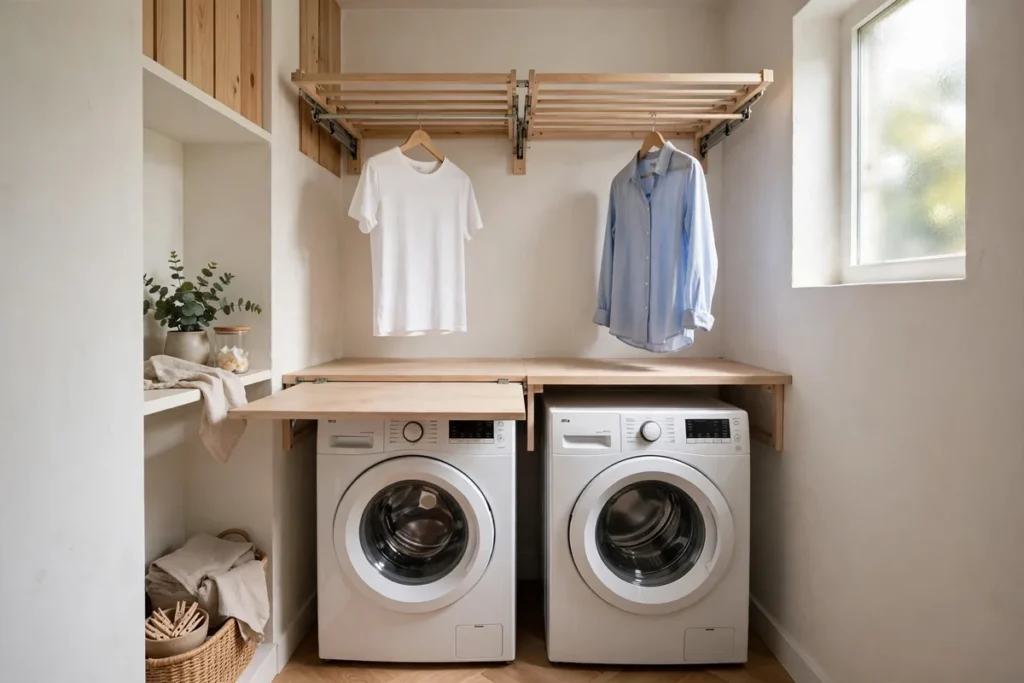
- Install a Fold-Down Counter
A wall-mounted fold-down shelf attaches with heavy-duty hinges and folds flat against the wall when you’re done. It gives you a surface roughly the size of a folding table for the cost of a few inches of depth. Choose one with support brackets rated for the weight you’ll put on it, and pick a depth that doesn’t block door swing.
- Add a Pull-Out Shelf Above the Dryer
A sliding board mounted above the machines can extend 12 to 18 inches when you need a surface and tuck neatly away when you don’t. It’s particularly handy in stacked setups where a full countertop isn’t possible.
- Use a Folding Cart or Over-the-Machine Board
A simple wooden or MDF board that rests across a side-by-side washer and dryer turns into a temporary folding table in seconds. Among all small laundry closet ideas for folding, make sure whichever you choose is securely mounted and doesn’t block the doors of the appliances. Store it behind the closet door or between the wall and the appliance when it’s not in use.
- Choose a Retractable Drying Rack
A retractable drying rack fixed to the wall folds out when you need to air-dry items and folds away when you’re done, so you aren’t giving up permanent floor space. A wall-mounted rack is ideal for keeping delicates flat, which protects sweaters, swimwear and lingerie from stretching.
- Try a Ceiling-Mounted Pulley Rack
If your closet has a decent ceiling height, a ceiling-hung rack on a pulley lets you lower it to load wet clothes and raise it out of the way, keeping the airspace above the machines productive. It’s a clever option for rooms that look stylish even when the laundry rack is lifted.
Small Laundry Closet Door Ideas That Save Space
The door is the most overlooked part of a laundry closet. A standard swing door needs clear floor space to open, which in a hallway is often the very thing you’re short on. It can also block access to the machines. Here are better options.
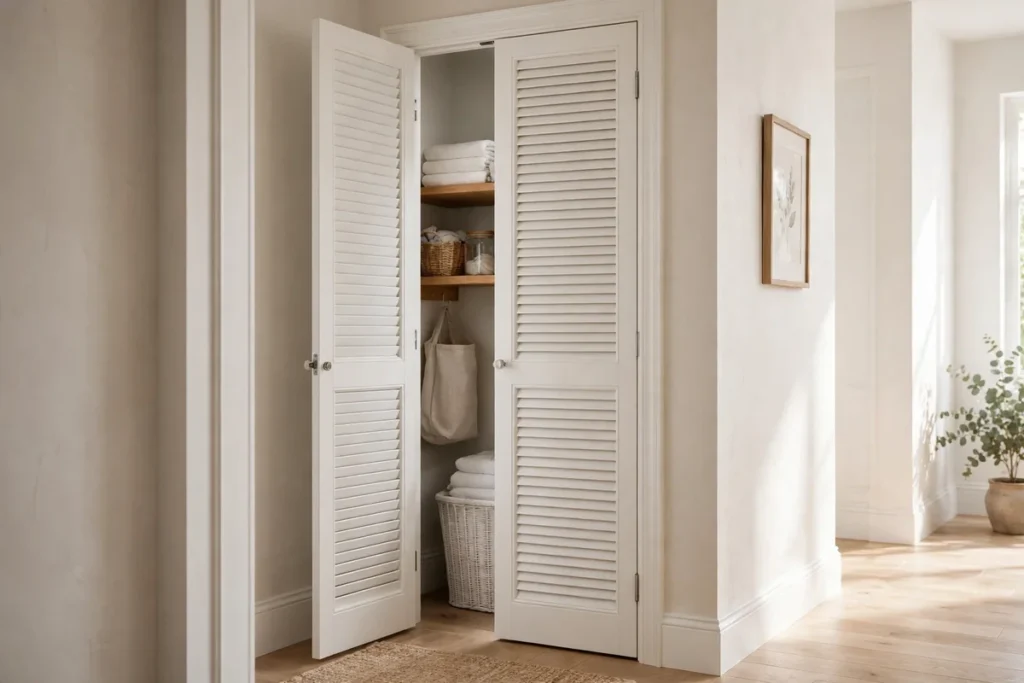
- Bifold Doors
Bifold doors fold in half and stay within the frame, so they’re a classic choice for hallway closets. They open wide enough for easy access while keeping the entry clear. Louvered bifolds have a bonus: they allow airflow, which helps a dryer breathe.
- Sliding or Barn Doors
A sliding door or barn-style door hangs on a track and glides open without needing floor clearance. It looks modern, it’s easy to match with the rest of your home and it lets you paint or wallpaper the front for a statement. Remember that a sliding door only opens half the width at a time, so make sure the opening gives you enough access to service the machines.
- Pocket Doors
A pocket door disappears into the wall when it’s open, which can widen a narrow corridor significantly compared with swinging doors. They’re more involved to install (they usually require opening up the wall), but they’re a favorite in remodels where every inch counts.
- A Curtain Instead of a Door
For the lowest-cost option, replace the door with a tension rod and a washable linen or cotton curtain. A curtain adds softness, hides clutter and lets air circulate. Match it to your bedroom or hallway decor and it will look like a deliberate design choice rather than a compromise.
- Remove the Door Altogether
If you’re renting, one of the simplest small laundry closet ideas is to take the door off its hinges and store it somewhere safe so you can put it back when you move out. With the door gone, you can wallpaper the walls, style the shelves and treat the closet like a mini room. Add attractive hinge plate covers if the hardware is visible.
Style-Focused Small Laundry Closet Ideas
A laundry closet doesn’t have to look like an afterthought. Because the space is so compact, a small design gesture goes a long way.
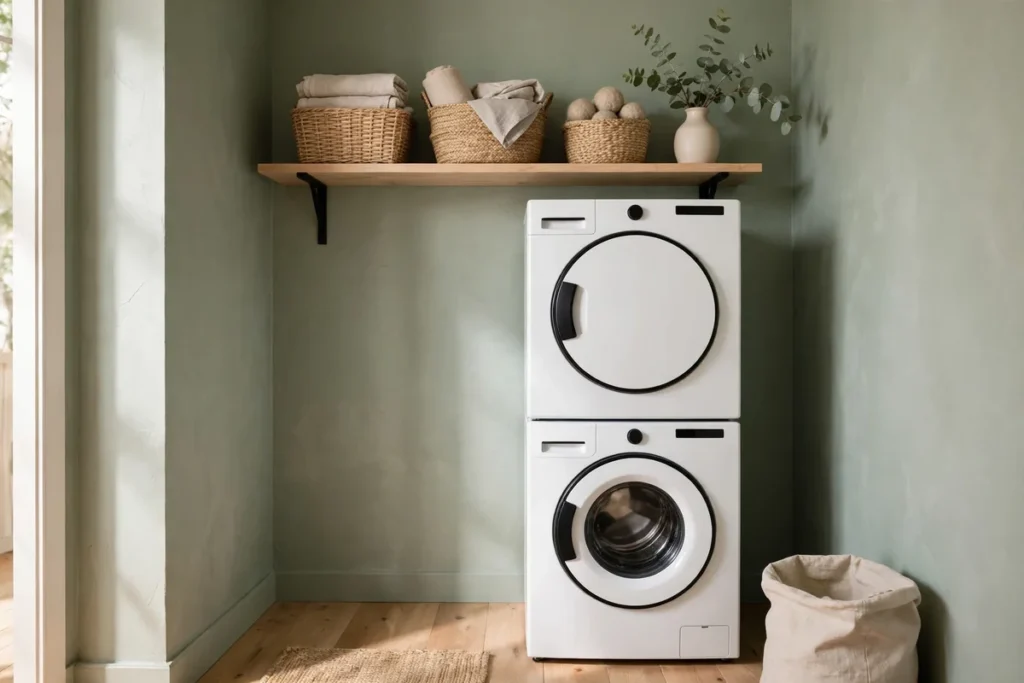
- Peel-and-Stick Wallpaper
Peel-and-stick wallpaper is the single most effective rental-friendly makeover. A bold botanical, a soft stripe or a whimsical woodland pattern instantly changes the personality of the closet, and it’s removable when you move. Smooth the walls first, clean off any dust or lint and work from the top down. Because laundry closets can get humid, choose a wipeable, moisture-resistant vinyl option.
- A Fresh Coat of Paint in a Light, Calming Color
If painting is allowed, soft white, pale sage, light blue or warm greige make a small space feel bigger and brighter. Use a washable satin or semi-gloss finish so you can wipe away dust and splashes, and paint the ceiling the same color or a shade lighter to push the walls outward visually.
- Swap the Hardware
Matte black, brushed brass or simple wooden pulls cost very little but change the whole mood. Replace door handles, shelf brackets and hooks so everything matches, and add hinge covers if they’re visible. It’s a tiny detail that makes a closet look custom.
- Add a Removable Chair Rail or Trim
A thin piece of trim or a removable chair rail attached with adhesive strips adds architectural interest without damaging walls. Paint above and below it in two shades, or wallpaper the top half only, for a bit of that custom-cabinetry feel.
- Bring in Small Touches of Greenery and Decor
A small pothos or a sprig of eucalyptus in a jar softens all that white plastic and metal. Add a framed print or a small wooden sign to the back of the door. Just keep decor light and away from the dryer’s heat and vent.
Lighting and Airflow: The Practical Side of Laundry Closet Design
- Add Lighting You Can Actually See By
Many closets have a single dim bulb at the back, which makes spotting stains nearly impossible. Battery-powered LED puck lights, plug-in under-shelf strips or motion-sensor lights solve it without any rewiring. Warm-white (around 3000K) is flattering, while a cooler neutral white helps you see stains better. Under-shelf lighting also gives the closet a warm, finished look at night.
- Prioritize Ventilation (Seriously)
This is the one idea you shouldn’t skip. A dryer produces heat, moisture and lint, and a closed closet can trap all three. Ventilation matters for comfort, for the life of your machines and for fire safety.
- Vent a vented dryer outdoors with a smooth, rigid or semi-rigid metal duct that’s as short and straight as possible. Avoid long, crushed or kinked foil or vinyl ducts.
- Check for crushed ducts when you push a stacked set back against the wall. A kinked vent restricts airflow, lengthens drying times and raises fire risk.
- Use louvered or vented doors, or leave small gaps at the top and bottom of the door so air can move in and out.
- Don’t store things against the dryer or pile baskets over its vents.
- Clean the lint trap every load and the vent duct regularly, following the manufacturer’s guidance.
- Consider a ventless dryer (heat pump or condenser) if you can’t run a duct outdoors. They still need some air circulation around them.
If you’re unsure about local requirements or a code, ask a qualified appliance installer or check your appliance manual. When it comes to dryer vents, it’s not the place to guess.
Small Laundry Closet Ideas by Location: Hallway, Bedroom, Kitchen and Bathroom
Where your closet sits changes which small laundry closet ideas make sense. A few quick notes on the most common spots:
Hallway Laundry Closet
Hallway closets are the classic apartment setup, and the biggest issue is traffic. People walk past, doors swing into the corridor and noise carries. Sliding, bifold or pocket doors keep the passage clear, while a solid-core door and soft-close hardware help dampen the sound of a spin cycle. Because the closet is visible from the hall, it’s worth wallpapering the inside so it looks pretty whenever the doors are open.
Bedroom or Bedroom-Adjacent Closet
If your machines sit near sleeping areas, noise and humidity are the priorities. Use anti-vibration pads under the machines, choose a quieter model if you’re buying new and consider acoustic panels or sound-dampening materials on the closet walls. A curtain or door that matches your bedroom decor helps the space blend in, and a ventilated door keeps moisture from drifting into the room.
Kitchen Corner or Pantry Closet
Kitchens already have water lines and drains nearby, which makes them practical locations. The challenge is keeping lint and detergent away from food. Keep a dedicated closed cabinet or tall basket for laundry supplies and wipe down surfaces often. A door that matches your cabinetry will make the machines nearly invisible.
Bathroom Laundry Closet
Bathrooms already deal with humidity, so choose moisture-resistant materials, wipeable paint and vinyl wallpaper that tolerates steam. A tall, narrow cabinet can double as storage for towels and cleaning supplies, and good ventilation (an exhaust fan plus vented closet doors) will protect both your machines and your walls.
Entryway or Mudroom Closet
In an entry closet, laundry often shares space with coats and shoes. A tall pull-out rack, a cubby bench and a few durable hooks keep both functions separate. Keep the dryer vent unobstructed and avoid piling winter gear against the machines.
Sample Small Laundry Closet Layouts by Size
To help you picture what’s possible, here are three common closet sizes and how designers typically approach them. Treat the dimensions as starting points and confirm everything against your own appliances.
Very narrow closet (about 30 to 36 inches wide)
- Best machine setup: Compact stacked washer and dryer, or a washer-dryer combo
- Top storage moves: Shelves above, narrow slide-out cart, door hooks, wall-mounted drying rack
- Best door choice: Louvered bifold, curtain or no door
Standard closet (about 3 to 4 feet wide)
- Best machine setup: Full stacked front-load set
- Top storage moves: Two floating shelves, baskets, fold-down shelf, over-the-door organizer
- Best door choice: Bifold or sliding barn door
Wide hall closet (5 feet or more)
- Best machine setup: Side-by-side with countertop
- Top storage moves: Countertop folding surface, upper cabinets, pull-out hamper, pedestal drawers
- Best door choice: Pocket, sliding or bifold
What Do Small Laundry Closet Ideas Cost? A Realistic Budget Guide
Costs vary a lot by region and by whether you do the work yourself, so treat these as rough ranges rather than quotes. The good news is that most of the high-impact small laundry closet ideas on this list are affordable.
- Baskets, labels and bins: $15 to $60 (very easy)
- Over-the-door organizer and hooks: $10 to $40 (very easy)
- Peel-and-stick wallpaper: $30 to $120 (easy)
- LED puck or strip lighting: $15 to $50 (easy)
- Floating shelves (set of two or three): $40 to $150 (moderate)
- Retractable or wall-mounted drying rack: $40 to $150 (moderate)
- Fold-down shelf or counter: $50 to $200 (moderate)
- Bifold, sliding or pocket door: $100 to $600 or more (moderate to professional)
- Custom built-in cabinetry: $1,000 to $4,000 or more (professional)
If your budget is tight, start with the cheapest changes that solve your biggest daily annoyance. A few matching baskets and a set of hooks often do more for your sanity than an expensive renovation.
Common Mistakes to Avoid in a Small Laundry Closet
- Ignoring ventilation. Closing a hot dryer in a sealed, unvented closet traps heat and humidity.
- Measuring only the machines. Forgetting door swing, hoses, vents and delivery access creates expensive surprises.
- Hanging shelves too low. You must still be able to open the dryer door and the washer’s detergent drawer fully.
- Overloading shelves. Heavy bottles of liquid detergent need proper brackets screwed into studs.
- Stacking the wrong machines. Only stack models designed for it, with the right kit.
- Storing clutter, not essentials. Every item in a laundry closet should have a purpose. Old paint cans and holiday decor belong elsewhere.
- Forgetting about service access. Leave room, or use removable panels, so a technician can reach the machines.
- Choosing a door that fights you. If you’re always squeezing around it, replace it.
How to Keep a Small Laundry Closet Clean and Organized
A great set of small laundry closet ideas only works if the space is easy to maintain. A tiny closet gets messy fast, so build a quick routine.
- Every load: Wipe the lint trap and toss stray socks and receipts.
- Weekly: Wipe the tops of the machines, tidy the baskets and check that vents aren’t blocked.
- Monthly: Run a washer-cleaning cycle, wipe the door gasket and leave the washer door slightly open so it can dry out.
- Every few months: Vacuum behind and around the machines where lint collects, and check hoses for wear.
- Once a year: Have the dryer vent professionally cleaned, or clear it yourself following the manufacturer’s directions.
A one-in, one-out rule helps too. When you buy a new bottle of detergent, finish or recycle the old one before it takes over the shelf.
Also Read: How to Stop Your Closet Eating Your Mornings
Also Read: A Small Baby Closet That Actually Works: Zones, Sizes and a Weekend Plan
Also Read: How to Stop a Bathroom Feeling Cluttered (Without a Renovation)
Also Read: How to Make a Walk-In Closet Feel Like a Boutique
Also Read: 56 Studio Apartment Ideas to Make One Room Feel Bigger, Smarter and Way More Like Home
Also Read: How to Make a Sloped Ceiling Bedroom Feel Cosy, Not Cramped
Final Thoughts on Small Laundry Closet Ideas
A small laundry closet doesn’t have to be a daily source of frustration. By measuring carefully, choosing the right layout, using vertical space and adding a fold-down surface, a drying rack, a better door and a little style, you can turn even a tight hallway closet into a space that works hard and looks good doing it.
Start small. Pick the one problem that annoys you most, whether it’s clutter, nowhere to fold or a door that gets in the way, and solve that first. Then layer in the rest over time. The best small laundry closet ideas aren’t the most expensive ones. They’re the ones that fit the way you actually do laundry.
Frequently Asked Questions About Small Laundry Closet Ideas
What is the minimum size for a laundry closet?
For a stacked washer and dryer, the minimum workable size is around 30 inches wide, 30 inches deep, and 72 inches tall (A few inches more depth and height make the space much easier to work with). Side by side machines need at least 60 inches of width.
Can I put a washer and dryer in a closet?
Yes, as long as you have the required water, drain, and power or gas hookups, proper venting, and access for maintenance. Always check your local building codes and the machine manufacturer’s clearance requirements, especially for vented dryers.
How do I maximize space in a tiny laundry closet?
Stack the machines, use vertical storage with shelves above the washer and dryer, add slim wall-mounted pull-out racks, and use labeled bins and baskets to keep everything visible and easy to reach.
How deep does a laundry closet need to be?
Most front-load machines are about 24 to 28 inches deep. Allow an extra 4 to 6 inches behind them for hoses and dryer vents so the doors close comfortably.
Should laundry closets have doors?
Yes, doors help hide clutter and reduce noise, but they need ventilation. Louvered doors, pocket doors, or a small vent in the door are good options.
How do I keep a laundry closet from smelling musty?
Good airflow is key. Leave the washer door open after each wash, wipe the door seal regularly, run a monthly cleaning cycle, and use a vent or a small dehumidifier to reduce the moisture.
What is the best storage for a small laundry room?
Open shelves above the machines, wall cabinets, slim pull-out drawers, hooks on the side wall, and labeled baskets for detergents and supplies. Keep daily items at eye level and bulk stock higher up.
Can a laundry closet be in a bedroom?
Yes, a laundry closet can be built into a bedroom closet or a nearby nook, but it requires proper plumbing, drainage, and dryer venting. A quiet, vibration-dampening pad can also help reduce noise.
How much does it cost to build a small laundry closet?
Costs vary by location and scope, but a simple conversion can cost a few thousand dollars, while a full renovation with plumbing, electrical work, and custom cabinetry can be significantly more. Always get multiple quotes and check permits.
What size is a standard laundry closet?
A standard laundry closet is at least 60 inches wide, 30 to 36 inches deep, and 72 inches tall for side by side machines. For a stacked setup, a closet of about 30 inches wide and 30 inches deep can work if you have the necessary height.