

Dark blue can make a living room feel intimate and calm, or it can make it feel cold and closed in. The difference is rarely the shade itself. It is the combination of light, contrast and texture around it. A room with pale furniture, warm lighting and a light ceiling can carry a deep navy wall with ease, while the same wall in a room with dark furniture and a single ceiling light will feel heavy.
For a typical living room of about 4 by 5 metres, allow a weekend for painting, about £200 to £400 for paint, primer, brushes and masking if you do the work yourself, and two 5-litre tins for two coats on four walls, depending on the existing colour. The decision to make first is not which named shade to buy, but how much dark colour the room can carry, and where the light in the room comes from.
This guide works through that decision in order: why dark blue feels different in different rooms, shade and undertone, how much wall to paint, furniture and contrast, lighting, accent colours, small rooms, and testing.
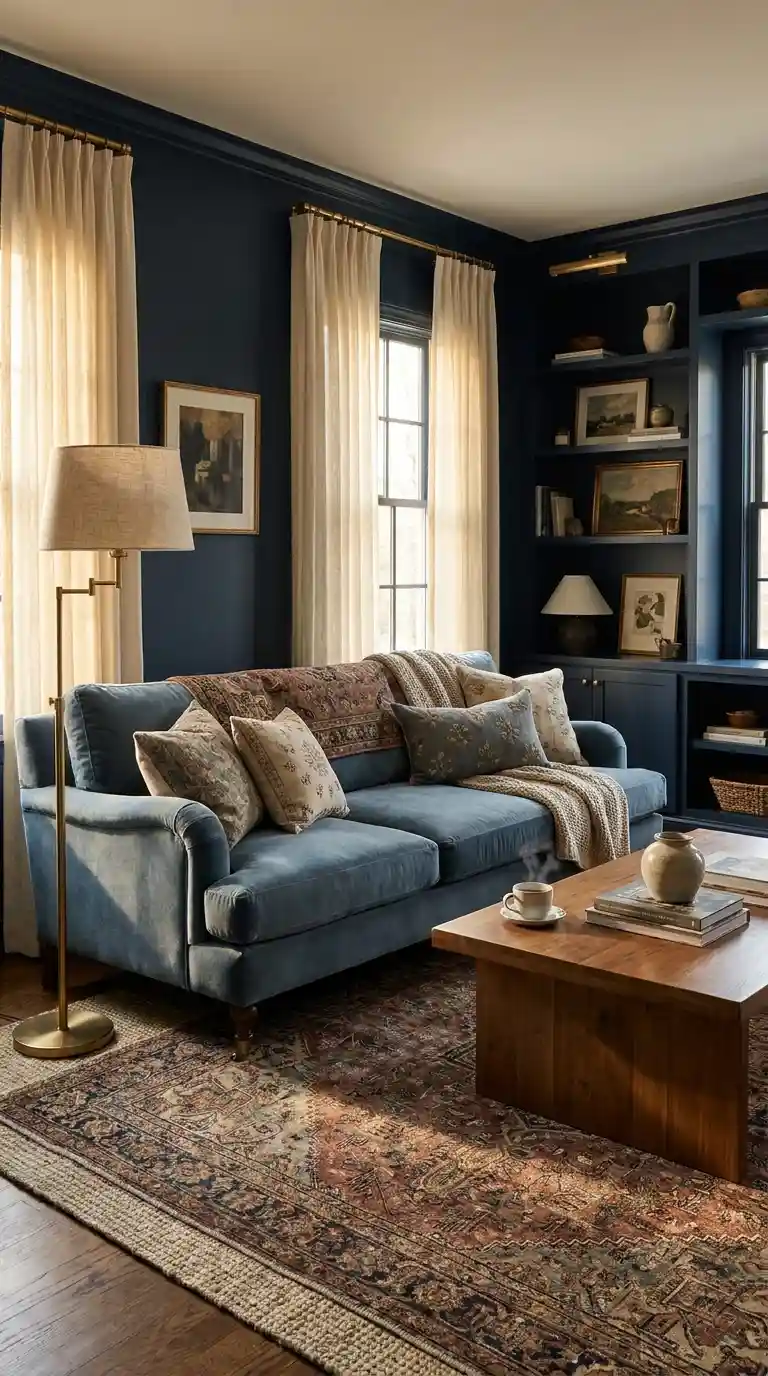
Why does dark blue feel cosy in some rooms and gloomy in others?
Dark colours absorb light, so they reduce the amount of light bouncing around a room. In a room with good daylight, warm lamps and light furniture, that absorption creates depth and makes the room feel enveloping rather than empty. In a room with little daylight, dark furniture and a dark floor, the same absorption removes the remaining contrast, so the room feels flat and closed in.
The practical test is to look at the room at 8 p.m. with the lights you actually use, not at noon with the curtains open. If the room already feels dim at night in a light colour, a dark colour will need a lighting upgrade first, not a paint change. If the room feels bright and a little stark at night, a dark wall can add the warmth and depth it is missing. Ceiling height also matters: a ceiling below 2.4 metres will feel lower if it is painted dark, so keep the ceiling white in most rooms.
Which shade of dark blue suits your light?
Undertone is more important than the name on the tin. A navy with a grey undertone looks calm and classic in most light. A navy with a purple undertone can look almost black in a north-facing room, while a teal or petrol blue with a green undertone looks richer in warm evening light but can look muddy in cool daylight. Check the undertone by holding the sample against a white card and against your sofa fabric, rather than against the paint chart.
For a north-facing room, choose a dark blue with a warm or neutral undertone and avoid the darkest midnight shades, which will read as black for much of the day. For a south-facing room, a cooler navy or indigo can work well, because strong daylight keeps the colour readable. For a room with little natural light, choose a blue that is one step lighter than the shade you first liked, because artificial light at 2700K will make it look darker than it does in the shop.
Should you paint all four walls, or just one?
Painting all four walls works best in a room at least 4 metres wide, with a light ceiling, light trim and at least two light sources. That full immersion creates a cocooning effect that suits evening use, and it avoids the hard edge where a dark accent wall meets a pale wall. Painting the trim and doors the same dark colour, a technique often called colour drenching, works only if the room has good lighting and the woodwork is in good condition, because every mark shows on a dark surface.
One accent wall is the safer choice for a smaller room, a room with a dark floor, or a first attempt at dark colour. Choose the wall behind the sofa or the fireplace, not a side wall, so the colour reads as a backdrop rather than a barrier. Keep the other walls in a warm white or pale grey that shares the same undertone as the dark blue, so the junction does not look like two unrelated rooms. The same logic applies to other dark rooms; for a narrower space, see how a single dark wall is used in this guide to painting a hallway, where one bold wall is balanced by light trim and a light ceiling.
What furniture keeps a dark room from feeling heavy?
Contrast is the key. A cream, pale grey or natural linen sofa against dark blue walls gives the eye a place to rest and keeps the room from feeling like a single dark block. Furniture with visible legs, such as a sofa on tapered legs or a coffee table on slim legs, also helps, because the floor remains visible and the room feels less crowded. Warm wood, such as walnut or oak, adds warmth that a dark blue wall alone cannot provide.
Avoid matching a navy sofa to navy walls in a small room, because the sofa will disappear into the wall and the room will lose its focal point. If a dark sofa is already in place, add a pale rug at least 160 by 230 centimetres under the main seating area, pale cushions, and a light-coloured throw, so the seating area is defined. Brass or gold hardware, picture frames and lamp bases add warmth in small amounts; use them as accents, not as a theme, so the room does not feel like a stage set.
How much light does a dark blue room actually need?
Plan for at least three light sources: a ceiling light, a floor or table lamp for reading, and a low-level lamp or wall light for evenings. In a room of about 20 square metres, aim for roughly 1,500 to 2,000 lumens from the ceiling light and 400 to 800 lumens from each lamp, all at a warm colour temperature of about 2700 to 3000K. Cool white bulbs at 4000K or above can make dark blue look grey and clinical, so avoid them in the evening.
During the day, keep window treatments light. Sheer curtains or a light roller blind will let daylight in while still giving privacy, whereas heavy dark curtains will remove the daylight the room needs most. Place a large mirror opposite or beside a window to reflect light, not directly opposite a dark wall, where it will reflect darkness. If the room has a fireplace, use it as a focal point in the evening, because a warm firelight or a group of candles adds the kind of low, warm light that suits dark blue best.
What accent colours work, and which clash?
Brass and gold, warm white, terracotta, blush pink and warm wood tones all work with dark blue, because they add warmth without competing with the wall colour. Use one or two of those accents consistently, rather than all of them at once. A brass lamp, a terracotta cushion and a pale rug, for example, give a room a coherent palette, while adding emerald green, bright red and orange in the same room will make the space feel busy.
Pattern should also be limited. Choose one bold pattern, such as a patterned rug or a set of curtains, and keep other textiles plain or subtly textured. Velvet, wool, linen and natural wood together give a dark blue room the texture it needs, because a single flat texture can make a dark room feel one-dimensional. If the room is also used as a family room, the same restraint applies to children’s items: keep toys and games in a closed storage unit, so the dark wall remains the backdrop rather than competing with bright plastic.
How do you make a small dark blue room work?
In a room under about 15 square metres, paint one wall dark blue and keep the other walls pale, the ceiling white, and the furniture light and leggy. Use a mirror to reflect a window, and keep the rug pale and large enough to anchor the seating area, rather than a small dark rug that disappears into the floor. Avoid a large, dark bookcase on the dark wall, because it will remove the contrast that makes the wall readable.
Keep the number of colours in a small dark room to three: dark blue, warm white, and one warm accent, such as brass or terracotta. That limit prevents the room from feeling crowded, even if the furniture is varied. The same principle helps in a smaller bedroom, where a dark accent wall can work if the rest of the room stays light; see this guide to a teenage boy’s bedroom for how a single dark wall is balanced by light bedding and a light ceiling in a compact room.
How do you test and paint it without regret?
Paint a test area at least 60 by 60 centimetres on the wall that will be dark, in two coats, and look at it in morning daylight, in afternoon light and in the evening under your lamps. Leave it for at least three days, because a dark colour changes more between day and night than a pale colour does. Test the colour against the sofa fabric, the rug and the floor, not against the paint chart, and test a second shade one step lighter if you are unsure, rather than buying full tins and hoping.
Allow two coats for an even dark colour, with primer if you are covering a pale wall or a stained surface, and about 4 hours of drying time between coats for most water-based paints. A matt or eggshell finish looks richer than a gloss on a dark wall and shows fewer imperfections, while a satin finish is easier to wipe clean in a high-traffic area. Plan the work over a weekend: day one for preparation and priming, day two for two topcoats, and 24 hours before moving furniture back against the wall.
Frequently asked questions
Does dark blue make a living room look smaller? Not necessarily. In a room with good light, light furniture and a white ceiling, dark blue walls can recede and make the room feel deeper, rather than smaller.
What colours go best with dark blue? Brass and gold, warm white, terracotta, blush pink and warm wood tones all pair well, because they add warmth without competing with the wall colour.
Is dark blue suitable for a room with little natural light? It can work, but it needs strong, warm, layered lighting and light furniture. Without those, a pale wall is usually a safer choice.
Should I paint the whole room or just one wall? Paint all four walls only in a larger, well-lit room. In a smaller room, or for a first attempt, paint one wall and keep the others pale.
What finish is best for a dark blue wall? A matt or eggshell finish looks richer and shows fewer imperfections than gloss, while a satin finish is easier to clean in a high-traffic area.
Start with light and contrast, not with a shade name. If the room has good daylight, warm lamps and light furniture, a deep navy can feel cosy and intentional. If it does not, add light and contrast first, or keep dark blue to one wall. Either way, a 60-centimetre sample, three days of looking at it, and a white ceiling will prevent most of the expensive mistakes.





4 Comments on “Dark Blue Living Rooms That Feel Cosy, Not Gloomy: A Practical Guide”