
Most hallways are only 0.9 to 1.2 metres wide and 3 to 5 metres long, yet they set the tone for every room beyond them. A tired, scuffed wall colour makes the whole home feel less cared for, while a considered colour makes even a plain corridor feel deliberate. The good news is that a hallway is also one of the cheapest rooms to repaint.
For a typical hallway, allow a weekend, about £90 to £180 for paint, primer, brushes, masking tape and dust sheets if you do the work yourself, and one 5-litre tin of wall paint for two coats. The one decision that matters most is not the exact shade on the chart. It is whether the colour, finish and lighting work together in a narrow space that is often lit only by a front-door fanlight or a ceiling light.
This guide works through that decision in order: light, colour, layout, finish, budget and testing. It uses general guidance and standard paint coverage figures, so you can adapt it to a Victorian terrace, a flat or a new-build home without needing a specialist finish.
Why does a narrow hallway feel darker than it really is?
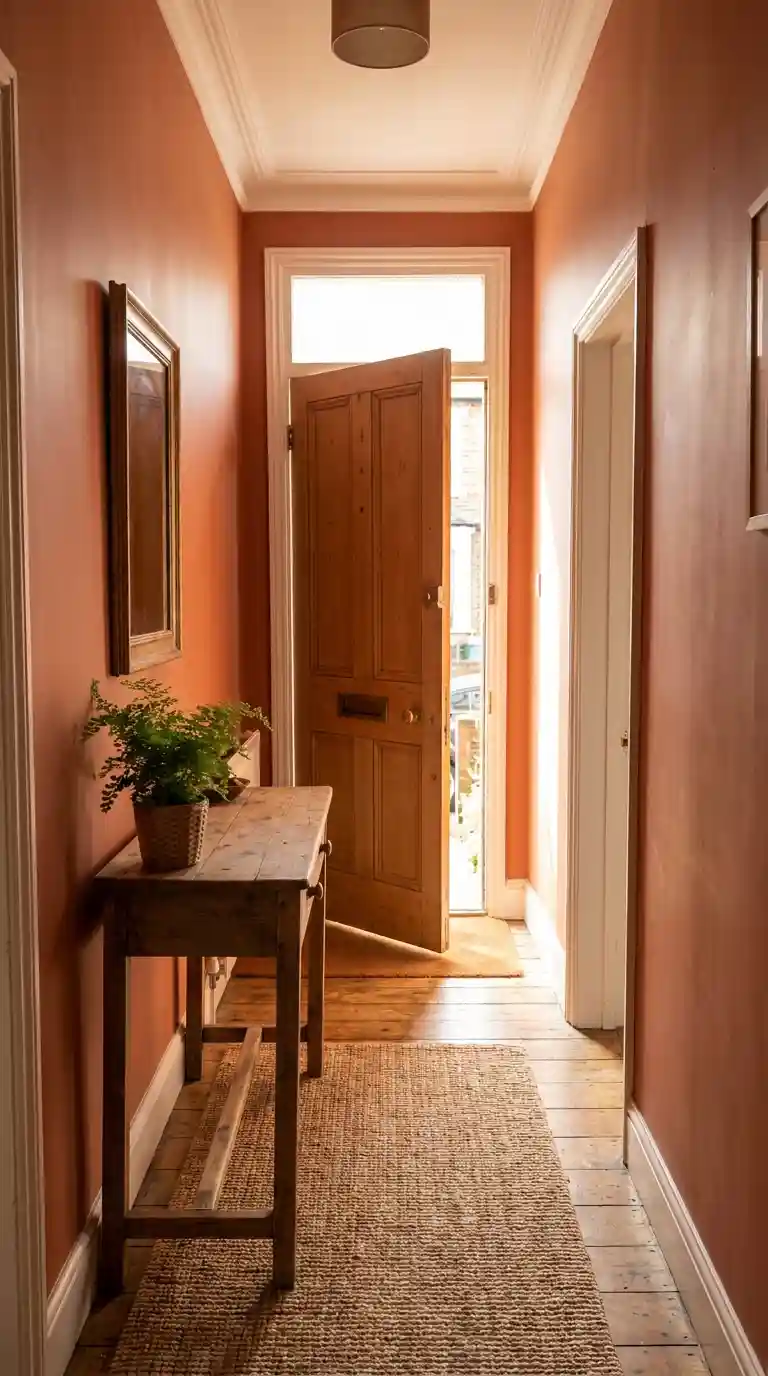
A hallway usually has fewer windows, more doors and less wall area visible at any one time than a living room. Light bounces from wall to wall, so a colour that looks soft in a shop can look two shades darker once it is surrounded by doors, skirting and a dark floor. Shadows from door frames and a low ceiling add to the effect, which is why the same paint can feel calm in one home and gloomy in another.
The practical answer is to judge a colour in the hallway itself, not in isolation. Check how it looks against the floor, the stair carpet and the rooms it connects to. If the adjoining rooms are warm white and the hallway is cool grey, the junction will stand out every time you walk through it. A colour with a warm undertone usually sits more comfortably with timber floors and cream woodwork.
What colour actually works in a one-metre-wide passage?
For most narrow hallways, start with a warm white, a pale greige or a muted sage. Look for a light reflectance value, usually printed on the paint chart, of about 70 or higher for the main wall colour. That level reflects enough light to keep the space open without the harsh, clinical feel that a pure brilliant white can give under LED ceiling lights.
Avoid choosing from a tiny printed chip alone. A 60-centimetre square sample on the wall tells you far more than a 5-centimetre chip, because it shows how the colour changes near the skirting, under the ceiling light and beside a door. If two shades look almost identical on the chart, choose the warmer one for a north-facing or windowless hallway, and the cooler one only if the space already gets strong daylight.
Should you go dark, or keep it light?
Dark colour is not automatically a mistake, but it needs a reason and a balance. It works best when the hallway is at least 1.2 metres wide, has a light ceiling and light woodwork, and is not the only route to a bedroom or bathroom at night. In that setting, a deep navy or forest green on the walls, with a white ceiling and a mirror at the end, can feel intentional rather than closed in. For a sense of how deep colour behaves in a larger room, see these dark blue living room ideas and note how often the darkest wall is paired with pale furniture and warm lighting.
Keep the main walls light if the hallway is under 1 metre wide, has no window and has a dark floor. In that case, use dark colour only as an accent: the end wall, the inside of a doorway, or a painted stair riser. That gives you the drama without reducing the light that reaches the middle of the passage, which is where a dark hallway usually feels most oppressive.
How do you split colour without chopping the space in half?
A two-tone split works when the line is at a height that already exists in the room. The most reliable choice is a dado or chair rail at about 90 centimetres, with the deeper colour below and the lighter colour above. That ratio keeps the darker area low, where it grounds the space, and leaves the upper wall and ceiling light. Painting the split at a random height, such as halfway up a 2.4-metre wall, tends to make the ceiling feel lower.
If there is no rail, use the door frames and skirting as the guide instead. Keep all trim, doors and skirting in one consistent white, and change only the wall colour. That single decision does more for a sense of continuity than any feature wall. The same principle applies to a single bold wall: choose the wall you see first when you enter, rather than a side wall you pass in a second, so the colour reads as a deliberate focal point, as with patio wall decor ideas that concentrate interest on one surface rather than spreading it everywhere.
What finish survives shoes, bags and pets?
Choose an eggshell or satin finish for hallway walls. Matt paint marks easily at hand height and around light switches, while a full gloss can highlight every bump in an older wall. Eggshell sits in the middle: it can be wiped with a damp cloth, it reflects a little light, and it does not show imperfections as harshly as gloss. Use a satin or semi-gloss only for trim, doors and skirting, where the harder surface is an advantage.
Allow two coats for an even colour, with about 4 hours of drying time between coats for most water-based paints, and avoid hanging pictures or leaning furniture against the wall for at least 24 hours. In a high-traffic hallway, a mid-tone colour will also hide scuffs better than a very pale or very dark one, because dust and shoe marks show less clearly against it. Keep a small amount of leftover paint, labelled with the room and shade, for touch-ups.
How much paint, time and money should you allow?
Measure before you buy. A hallway 4 metres long and 2.4 metres high has about 19.2 square metres of wall on two sides. Subtract roughly 2 square metres for each standard door, then double the remaining area for two coats. At a typical coverage of 10 to 12 square metres per litre per coat, that example needs about 3 to 4 litres, so a 5-litre tin leaves a sensible margin for touch-ups. A longer hallway, a stairwell or a colour change from dark to light may need primer and a second tin.
Plan the work over two days. Day one is for filling, sanding, masking and priming any patched areas. Day two is for cutting in around trim and rolling two coats. A professional painter would typically charge several hundred pounds for the same job, depending on region and preparation, so doing it yourself is where most of the saving comes from. Do not cut the budget by skipping primer on a dark or stained wall, because a third topcoat usually costs more in paint and time than the primer would have done.
What should renters do when repainting is not allowed?
Check the tenancy agreement first, and ask in writing if the wording is unclear. Many landlords will agree to a neutral repaint if you offer to return the walls to their original colour at the end of the tenancy, so put that offer in the same message. Keep the approval, the agreed shade and a note of the original colour, because a verbal agreement is difficult to prove later.
If repainting is refused, use removable options that do not damage plaster: peel-and-stick panels on one wall, a large framed print or mirror at the end of the hallway, and a runner in a warm colour to break up a cold floor. Those changes affect how the hallway feels without changing its structure, and they can be removed in under an hour. Avoid drilling into a freshly painted rental wall for a feature that could have hung from an existing picture rail.
How do you test a colour before committing?
Buy sample pots, not full tins, and paint a test area at least 60 by 60 centimetres on the wall that gets the least light. Paint two coats, because a single coat always looks lighter than the finished result. Leave the sample for at least three days and look at it in morning daylight, in the evening under the ceiling light, and at night when the front door is closed.
Compare the sample with the floor, the stair carpet and the nearest room, not with the paint chart. If the sample looks grey in the morning and warm in the evening, that is normal: artificial light adds warmth. The decision to make is whether you can live with the evening version, because that is the version you will see most often in winter. If you are still unsure after three days, test a second shade one step lighter, rather than buying a full tin and hoping.
Frequently asked questions
How much paint do I need for an average hallway? For a hallway about 4 metres long with two 2.4-metre walls, allow one 5-litre tin for two coats, plus primer if you are covering a dark colour or stained plaster.
Can a dark colour work in a windowless hallway? Yes, if it is used on one wall only, with a white ceiling, light trim and warm artificial lighting. Painting all four walls dark in a narrow, windowless space usually makes it feel smaller.
Is eggshell or matt better for a hallway? Eggshell is usually the safer choice, because it can be wiped clean and resists scuffs better than matt, while still looking soft rather than shiny.
Should hallway trim be the same colour as the walls? Keeping trim, doors and skirting in a consistent white gives the clearest, most continuous look, especially where the hallway connects several rooms with different colours.
How long should I wait before using the hallway normally? Most water-based paints are touch-dry in 2 to 4 hours and ready for a second coat in about 4 hours, but allow 24 hours before leaning furniture against the wall and about two weeks before washing a newly painted area firmly.
Start with the light and the width, not with a shade name. If the hallway is narrow and dark, choose a warm light colour and a washable finish. If it is wider and well lit, one deep wall can add character without closing the space in. Either way, a 60-centimetre sample, three days of looking at it, and a consistent trim colour will prevent most of the expensive mistakes.





6 Comments on “How to Paint a Hallway So It Feels Lighter, Wider and Worth Walking Through”